No Comments

Is a Multi-Generational Home Right for You?

(Updated 10/28/25)

Picture this: three generations living under one roof, sharing meals, splitting bills, and creating memories together every single day. It might sound like a throwback to earlier times, but this living arrangement is actually making a serious comeback in modern America. And the reasons might surprise you.

If you’ve been scrolling through real estate listings lately, feeling that familiar knot in your stomach as you see prices that seem impossibly out of reach, you’re definitely not alone. The housing market has been challenging, to say the least. But here’s something interesting: more families are finding creative solutions to the affordability crisis, and one of the most popular options involves bringing multiple generations together under one roof.

Increase in Multi-Generational Living

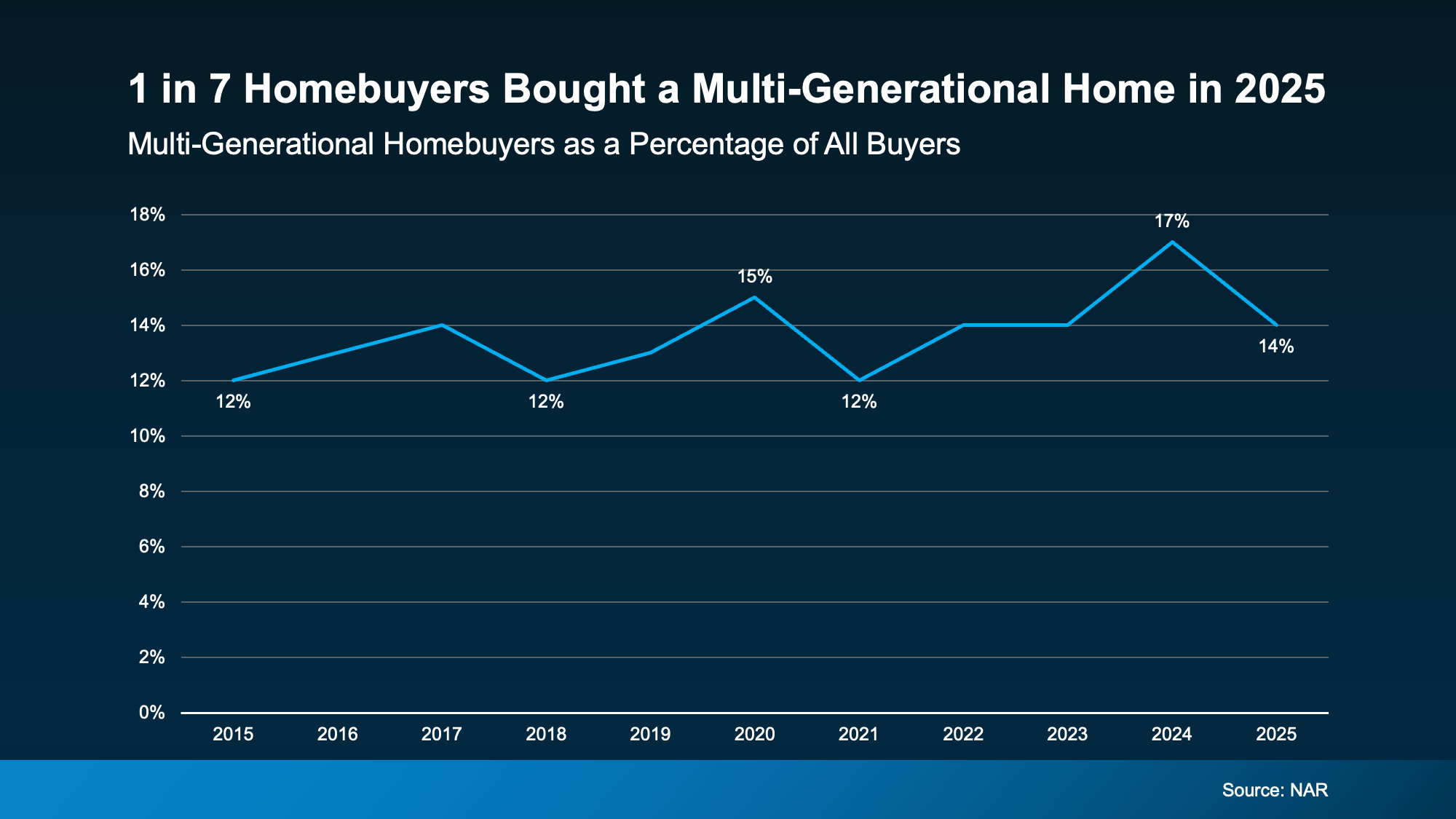
Let’s talk numbers for a second. Right now, about 17% of people buying homes are choosing multi-generational properties. That means nearly one in five homebuyers is purchasing a place to share with parents, adult children, or extended family members. The National Association of Realtors has been tracking this trend for years, and they’ve never seen numbers this high before.

Think about that for a moment. This isn’t just a small blip on the radar. It’s a significant shift in how Americans are approaching homeownership and family life. And it’s happening for reasons that make a lot of sense when you look at today’s economic landscape.

The Story Behind the Trend

Here’s where things get really interesting. In the past, when families decided to live together across generations, the main reason was usually caregiving. Adult children wanted to be close to aging parents who needed extra support, or grandparents stepped in to help with young grandchildren. And while that’s still a major factor, there’s a new motivation that’s taken the top spot: affordability.

Back in 2015, only about 15% of people buying multi-generational homes said cost savings was their primary reason. Fast forward to today, and that number has jumped to 36%. That’s more than double in less than a decade. What changed? Well, pretty much everything about the housing market.

Home prices have climbed steadily, mortgage rates have fluctuated significantly, and wages haven’t always kept pace with these increases. The result is that many people who would have easily qualified for homes in the past are now finding themselves priced out of the market. It’s frustrating, it’s stressful, and it’s affecting people across all age groups and income levels.

Pooling Resources Makes It Possible

Let’s break down why the multi-generational approach actually works so well from a financial perspective. When you’re trying to buy a home on a single income, or even as a couple, you’re limited by what you can afford based on your combined earnings. Your mortgage lender will look at your income, your debt, and calculate what they’re comfortable lending you. Sometimes that number is lower than what you need to get the home you want in the neighborhood you prefer.

But here’s where the magic happens: when you add another generation into the mix, you’re suddenly pooling multiple incomes. Maybe it’s you and your partner, plus your parents who still work or have retirement income. Or perhaps it’s you and your adult children who have established careers. Whatever the combination, you’re creating a stronger financial profile.

This isn’t just about qualifying for a loan, though that’s certainly part of it. It’s about the day-to-day reality of homeownership. Mortgages are just the beginning. There are property taxes, homeowners insurance, utilities, maintenance costs, and all those unexpected expenses that pop up when you own a home. When these costs are divided among multiple adults, the burden on any single person becomes much more manageable.

Think about it like this: if your monthly housing costs total $3,000, that might feel overwhelming if you’re shouldering it alone or splitting it just with a spouse. But divide that same $3,000 among four adults, and suddenly each person is only responsible for $750. That’s a game-changer for most family budgets.

Beyond the Payments

Here’s something else that’s pretty exciting about this arrangement: it might allow you to upgrade to a larger home than you could have afforded otherwise. When lenders look at multiple incomes, they can approve you for a bigger loan amount. This means more square footage, additional bedrooms, maybe an extra bathroom or two, and the space everyone needs to live comfortably without feeling cramped.

This is especially valuable when you consider that multi-generational living works best when everyone has some personal space. You’ll want separate bedrooms, possibly separate living areas, and ideally a floor plan that gives each generation a bit of privacy while still allowing for family time. A larger home makes all of this possible in a way that a smaller, more affordable single-family home might not.

And here’s the kicker: even with that larger, nicer home, you might still be paying less per person than you would if everyone was living separately in smaller places. It’s one of those rare situations where you actually get more for less.

The Sandwich Generation Solution

Have you ever heard the term “Sandwich Generation”? It refers to people who find themselves caring for both their children and their aging parents at the same time. If you’re nodding your head right now, you know exactly how challenging this can be. You’re pulled in multiple directions, trying to be there for your kids while also making sure your parents are okay. It’s exhausting, emotionally draining, and often financially straining.

Research shows that roughly one in six Americans falls into this category. That’s a lot of people juggling multiple caregiving responsibilities. But here’s an interesting finding: about a third of people in the Sandwich Generation say that their situation has actually made it easier for them to afford a home. How is that possible?

Well, when everyone lives together, there are some pretty significant advantages. If your parents contribute to the mortgage or help with other household expenses, that’s money you’re not spending entirely on your own. If your grandparents are home and can help watch the kids, you’re potentially saving hundreds or even thousands of dollars per month on childcare costs. For many families, these savings make the difference between being able to buy a home and continuing to rent.

The Non-Financial Benefits That Matter Just As Much

Look, we’ve talked a lot about money because, let’s be honest, that’s a huge factor in housing decisions. But there’s so much more to the multi-generational living story than just the financial angle.

When your parents or grandparents live with you, caregiving becomes so much easier. You’re not driving across town multiple times a week to check on them, help with medication, or take them to appointments. You’re right there, able to help when needed and enjoy their company when you’re not in full caregiving mode. For many families, this peace of mind is priceless.

There’s also something beautiful about the quality time aspect. In our busy, scattered lives, it’s easy for family connections to become limited to holiday gatherings and occasional phone calls. When you live together, you get those everyday moments. Your kids eat breakfast with their grandparents. You can share a cup of coffee with your adult daughter before everyone heads to work. Your aging parents get to see their grandchildren grow up, not through photos sent via text, but in real-time, right in front of them.

This kind of togetherness creates stronger bonds and more memories. Research has shown that older adults who live with family often experience better mental health outcomes. They feel more connected, less isolated, and more purposeful when they’re part of the daily rhythm of family life. For children growing up in multi-generational homes, the benefits are equally significant. They develop closer relationships with grandparents, learn to respect and care for older family members, and gain wisdom from multiple generations.

Finding the Right Home

Now, here’s where things can get a bit tricky. Finding a home that works for two, three, or even four generations isn’t quite as simple as your typical house hunt. You’ve got more people involved, which means more opinions, more needs, and more must-haves on your list.

You’ll want to think about things like bedroom placement. Maybe your elderly parents need a bedroom on the ground floor because stairs are becoming difficult. Perhaps your adult children want their bedrooms on a separate level for privacy. You might need multiple bathrooms to avoid morning traffic jams. Some families look for homes with separate living spaces, like a basement suite or an in-law apartment, that allow for independence while still being under the same roof.

Accessibility is another crucial consideration. If you’re planning for aging parents to live with you long-term, you’ll want to think about features like wider doorways for wheelchairs or walkers, grab bars in bathrooms, a step-free entrance, and maybe even a bedroom and bathroom on the main floor. Planning for these needs now can save expensive renovations later.

The kitchen and common areas matter too. Can everyone gather comfortably for meals? Is there enough seating? Do you have adequate storage for everyone’s belongings? These practical questions might seem mundane, but they make a huge difference in how well multi-generational living actually works day-to-day.

Working with a Real Estate Agent Who Gets It

This is where having the right real estate agent becomes absolutely essential. Not every agent has experience with multi-generational home searches, and the learning curve can be steep. You want someone who understands the unique challenges and can help navigate them efficiently.

A skilled agent will help you identify properties with the right layout before you even schedule a showing. They’ll know which neighborhoods have larger homes that fit your budget when you’re pooling resources. They can point out features you might not have thought about, like whether a basement could be finished to create additional living space, or if a property has the right zoning for adding an accessory dwelling unit in the future.

Your agent can also help facilitate conversations when multiple family members are involved in the decision-making process. When you’ve got parents, adult children, and maybe even grandparents all weighing in on properties, having a neutral professional who can keep everyone focused on the priorities is incredibly valuable.

The Momentum Behind This Trend

Here’s something that suggests this isn’t just a temporary blip: nearly three in ten homebuyers say they’re planning to purchase a multi-generational home. That’s 28% of people actively looking at real estate who are considering this option. These aren’t just people dreaming about it casually. These are buyers who are serious enough about homeownership to be out there looking, and they’re specifically interested in multi-generational properties.

What does this tell us? The trend isn’t slowing down. If anything, it’s gaining steam. As more families see friends and relatives successfully navigate multi-generational living, and as housing affordability continues to be a challenge, we’re likely to see these numbers grow even more.

The pandemic accelerated this trend too. When everyone was stuck at home, many families reevaluated what home meant to them. People who had been living far from aging parents suddenly felt the distance more acutely. Young adults who had been living on their own found themselves reassessing whether that independence was worth the financial strain. Families started asking bigger questions about what really mattered.

Making a Decision That’s Right for Your Family

So, is multi-generational living right for you? That’s a question only you and your family can answer. It requires honest conversations about expectations, boundaries, and how you’ll handle the inevitable challenges that come with multiple adults living together.

You’ll want to talk through the practical stuff: how will you split expenses? Who’s responsible for what household tasks? How will you handle different parenting styles if grandparents are living with grandchildren? What about privacy and personal space? These conversations might feel awkward, but having them before you move in together can prevent a lot of conflict down the road.

Consider the personalities involved too. Some families thrive in close quarters, while others need more independence. Some people are natural caregivers who find joy in helping aging parents, while others might find it stressful despite having good intentions. There’s no judgment either way, but being realistic about your family dynamics will help you make the best decision.

Financial Reality Checks

Let’s get specific about the money side for a moment. When you’re evaluating whether multi-generational living makes financial sense, sit down and run the actual numbers. Calculate what everyone is currently spending on housing separately. Add up rent or mortgage payments, utilities, internet, streaming services, groceries, and all those other costs that come with maintaining a household.

Now compare that to what it would look like if you were all living together. Factor in a larger home that could accommodate everyone, but remember to divide those costs among all the contributing adults. In most cases, you’ll find significant savings for everyone involved. These savings can be redirected toward other goals, whether that’s paying down debt, saving for retirement, building an emergency fund, or simply having more breathing room in your monthly budget.

When Multi-Gen Living Becomes a Long-Term Strategy

For some families, multi-generational living starts as a temporary solution but evolves into a permanent lifestyle choice. Maybe adult children move in to save for their own down payment, but they end up loving the arrangement and staying longer. Perhaps aging parents move in for caregiving reasons, but the family realizes how much they enjoy living together and decides to make it permanent.

This evolution is natural and perfectly okay. The beauty of homeownership is that you can adapt as your needs change. Maybe you start in a smaller multi-generational home and eventually upgrade to something larger. Or perhaps you modify your existing home to better accommodate everyone’s needs. Finishing a basement, adding a bathroom, or converting a garage into living space are all options that families explore as they settle into this lifestyle.

The Future of Housing

The rise in multi-generational living represents more than just individual families making choices about where to live. It reflects a broader shift in how Americans are thinking about housing, family, and community. In many cultures around the world, multi-generational living has always been the norm. The American trend toward nuclear families living separately was actually a relatively recent phenomenon, driven by post-World War II prosperity and cultural shifts.

In some ways, we’re coming full circle, rediscovering the benefits that previous generations knew well. But we’re doing it with a modern twist, combining traditional family structures with contemporary sensibilities about privacy, independence, and personal space.

As housing continues to be a challenge in many markets, multi-generational living offers a practical solution that also happens to bring families closer together. It’s efficient, it’s economical, and for many families, it’s emotionally fulfilling in ways they didn’t expect.

Taking the First Step

If you’re reading this and thinking, “Hey, this might actually work for my family,” the next step is simple: start the conversation. Talk to your family members about the possibility. Gauge their interest and openness to the idea. Discuss the pros and cons honestly.

Then, reach out to a local real estate agent who has experience with multi-generational home searches. They can help you understand what’s available in your market, what your pooled resources can afford, and what the process would look like. You might be surprised to find that homeownership is more achievable than you thought when you team up with your loved ones.

Remember, there’s no one-size-fits-all approach to housing. What works beautifully for one family might not be the right fit for another. But for the growing number of families who are choosing multi-generational living, it’s proving to be a solution that addresses both the practical challenges of today’s housing market and the timeless human need for connection and family.

Whether your motivation is primarily financial, caregiving-focused, or simply about wanting to live closer to the people you love, multi-generational homes offer a path forward that’s worth considering. In a housing market that often feels impossibly difficult to navigate, it’s refreshing to find an option that actually makes things easier while bringing families together.

The question isn’t whether multi-generational living is a trend that will stick around. The data suggests it’s here to stay. The real question is whether it might be the right choice for you and your family. And that’s a conversation worth having.

No Comments

What You Should Know About Closing Costs

(Updated 10/24/25)

So you’ve found the perfect house and you’re ready to make your homeownership dreams come true. That’s exciting! But before you start picking out paint colors and measuring for furniture, there’s something important we need to talk about – and no, it’s not just your down payment.

While most future homeowners obsess over saving enough for that down payment (and rightfully so), there’s another significant expense that catches way too many buyers off guard: closing costs. Think of these as the “behind-the-scenes” expenses that make your home purchase official and legal. Let’s dive into everything you need to know about these costs so you can budget smartly and avoid any unwelcome surprises when you’re ready to get those keys.

What Closing Costs Really Mean

Here’s the thing about closing costs – they’re not some mysterious concept designed to confuse you. They’re simply all the various fees and expenses that pile up during the final stages of your home purchase. These are the charges that make your transaction official, ensure the property is legally yours, and protect everyone involved in the deal.

Picture closing day like the finale of a big production. You’ve got the real estate agents, lenders, attorneys, inspectors, insurance companies, and government offices all playing their parts. Each one provides a service that makes your home purchase possible, and each one needs to be compensated. That’s essentially what closing costs cover.

What makes these expenses a bit tricky is that they’re not a single, straightforward charge. Instead, they’re a collection of different fees bundled together. Some are paid directly to your lender, others go to third-party service providers, and some cover government requirements. The total amount you’ll pay depends on various factors, including where you’re buying, the purchase price of your home, and how you’re financing the purchase.

What Goes Into Closing Costs

Let’s get specific about what you’re actually paying for when those closing costs hit your bank account. Understanding each component can help you see where your money is going and why these expenses exist in the first place.

Fees Related to Your Mortgage Application

When you apply for a home loan, your lender has work to do. They need to process your application, which means someone has to review all your financial documents, verify your income, check your employment history, and assess whether you’re a good candidate for the loan amount you’re requesting.

The application fee covers this initial processing work. Not every lender charges this fee, but when they do, it’s typically due when you submit your application and usually isn’t refundable if your loan doesn’t get approved.

Then there’s the credit report fee. Your lender needs to pull your credit report to see your credit score and payment history. This helps them determine what interest rate to offer you. The better your credit score, the better your rate will typically be, which can save you thousands over the life of your loan.

Origination Charges

Here’s where things can get a bit pricey. The loan origination fee is what your lender charges for actually creating your mortgage. Think of it as their service charge for doing all the heavy lifting involved in funding your home purchase.

This fee typically ranges from half a percent to a full percent of your total loan amount. So if you’re borrowing three hundred thousand dollars, you could be looking at fifteen hundred to three thousand dollars just for this one fee. That’s a significant chunk of change, which is why it’s so important to factor this into your budget early on.

Some lenders also charge a separate underwriting fee if it’s not already included in the origination fee. Underwriting is the detailed risk assessment process where the lender analyzes your financial profile to determine if they should approve your loan.

Property-Specific Expenses

Your lender wants to know they’re making a sound investment, which means they need to know exactly what the property is worth. That’s where the appraisal comes in. A licensed appraiser will visit the property, assess its condition, compare it to similar recently sold homes in the area, and determine its fair market value.

Appraisal costs can vary based on the size and complexity of the property you’re buying. A standard single-family home in a typical neighborhood will cost less to appraise than a unique property or one in a rural area where comparable sales are harder to find.

While not always required by lenders, getting a professional home inspection is one of the smartest investments you can make. An inspector will thoroughly examine the property’s structure, systems, and components to identify any existing problems or potential issues. This could save you from buying a home with hidden problems that could cost tens of thousands to repair down the road.

Title Services and Insurance

Title-related costs are often some of the most confusing for first-time buyers, but they’re absolutely essential. Before you can officially own the property, someone needs to verify that the seller actually has the legal right to sell it to you. This involves researching public records to make sure there are no outstanding claims, liens, or disputes regarding the property.

Title insurance protects both you and your lender if any issues with the property’s ownership emerge after the sale. There are actually two types of title insurance policies involved in most transactions.

Lender’s title insurance protects the mortgage company’s investment if someone later claims they have a legal right to the property. This policy is typically required by lenders, and you’ll pay for it even though it protects them, not you.

Owner’s title insurance is your protection. While it’s optional, it’s highly recommended because it safeguards your ownership rights. In some regions, it’s customary for the seller to pay for the owner’s policy, but this varies by location and can be negotiated.

Insurance

Before you can close on your home, you’ll need to have homeowners insurance in place. Your lender requires this to protect their investment in case your home is damaged or destroyed. At closing, you’ll typically pay for your first year’s premium upfront.

The cost of homeowners insurance varies dramatically based on your location, the value and age of your home, the coverage limits you choose, and your deductible. Properties in areas prone to natural disasters, like hurricanes or wildfires, will have significantly higher premiums than homes in lower-risk areas.

If you’re putting down less than twenty percent, you might also need to pay for private mortgage insurance, or PMI. This protects your lender if you default on your loan. For government-backed loans like FHA loans, there’s an upfront mortgage insurance premium that gets added to your closing costs.

Government and Legal Fees

When you buy a home, the transaction needs to be officially recorded with your local government. Recording fees cover the cost of updating public records to show that you’re now the legal owner of the property. These fees vary by location since different counties and municipalities set their own rates.

If you’re in a state that requires an attorney to be present at closing, you’ll need to budget for attorney fees as well. Even in states where it’s not required, having a real estate attorney review your documents and represent your interests can be worthwhile, especially for first-time buyers or complex transactions.

Additional Closing Expenses

There are several other miscellaneous fees that might show up on your closing statement. Survey fees pay for a professional to verify the exact boundaries of your property. This is particularly important if there are questions about property lines or if you’re buying land.

If your property is in a flood zone, you’ll encounter flood determination fees. These pay for a company to assess whether the property is at risk and to monitor if that risk level changes over time. If flood insurance is required, that’s an additional ongoing expense you’ll need to budget for beyond closing.

Tax monitoring fees cover the service of tracking your property taxes and ensuring they get paid on time. Some lenders handle this through an escrow account where they collect money from you each month and pay your taxes and insurance on your behalf.

Calculating Expected Closing Costs

Now that you understand what closing costs include, let’s talk numbers. The general guideline is that closing costs typically fall between two and five percent of your home’s purchase price. That’s a pretty wide range, but several factors influence where your costs will land within that spectrum.

Your location plays a huge role. States with higher property taxes, for example, will have higher closing costs. Areas that require attorney representation at closing will add legal fees to your total. The price of your home obviously matters too – five percent of a six hundred thousand dollar home is quite different from five percent of a three hundred thousand dollar property.

Let’s walk through a practical example. Say you’re purchasing a home for four hundred thousand dollars. Using that two to five percent guideline, your closing costs could range anywhere from eight thousand dollars on the low end to twenty thousand dollars on the high end. That’s a significant amount of money that needs to be available in addition to your down payment.

If you’re buying a more affordable home priced at two hundred and fifty thousand dollars, your closing costs might range from five thousand to twelve thousand five hundred dollars. On the other hand, if you’re purchasing a more expensive property at seven hundred thousand dollars, you could be looking at fourteen thousand to thirty-five thousand dollars in closing costs.

These are estimates, of course. Your actual costs will depend on your specific situation, but these calculations give you a ballpark figure to work with when planning your budget.

Strategies for Reducing Closing Costs

The good news is that closing costs aren’t entirely set in stone. There are several legitimate strategies you can use to potentially reduce what you’ll pay at closing. Let’s explore some of the most effective approaches.

Negotiating with the Seller

In today’s real estate market, buyers often have more negotiating power than they might realize, especially if homes in the area are taking longer to sell. Sellers who are motivated to close the deal may be willing to help with your closing costs.

You can ask the seller to pay for specific expenses like the home inspection or provide you with a credit toward your closing costs. This is called a seller concession. The amount they’re willing to contribute often depends on market conditions, how long their home has been listed, and how motivated they are to sell.

This negotiation typically happens during the offer stage. Your real estate agent can help you craft an offer that includes a request for seller-paid closing costs without making your offer less attractive overall. Sometimes it makes sense to offer a slightly higher purchase price in exchange for the seller covering a portion of your closing costs, especially if you’re stretching to come up with cash at closing.

Shopping Around for Services

Not all closing costs are negotiable, but some are. You have the right to shop around for certain services like homeowners insurance, title services, and even some lender fees. Taking the time to compare options can lead to significant savings.

Homeowners insurance is an area where shopping around really pays off. Different insurance companies offer varying rates for similar coverage. Getting quotes from at least three different insurers can help you find the best combination of price and coverage. Don’t just go with the cheapest option, though – make sure you understand what’s covered and what’s excluded.

Some buyers don’t realize they can shop for title services. Your lender might suggest a title company, but you’re not obligated to use them. Getting quotes from different title companies could save you several hundred dollars, though in some areas, title fees are more standardized.

Assistance Programs

If closing costs are a significant financial hurdle, you might qualify for assistance programs that can help. These programs exist at the federal, state, and local levels, and they’re designed to help buyers overcome the upfront cost barriers to homeownership.

Many first-time buyer programs include assistance with closing costs, not just down payments. Some programs offer grants that don’t need to be repaid, while others provide low-interest loans. Eligibility requirements vary, but they often consider factors like your income level, the location where you’re buying, and whether you’re a first-time buyer.

Certain professions may also qualify for special programs. Teachers, healthcare workers, law enforcement officers, and veterans often have access to programs that can help with closing costs. Your real estate agent should be familiar with local programs and can point you in the right direction.

The Department of Housing and Urban Development maintains resources to help you find homebuying assistance programs in your area. Many state housing finance agencies also offer programs worth exploring. It’s worth spending some time researching what’s available – the money you save could make the difference between being able to afford your dream home or having to keep looking.

Timing Your Closing Strategically

Here’s a lesser-known strategy: the timing of your closing can affect your costs. You’ll need to prepay interest on your mortgage from the closing date until your first payment is due. If you close early in the month, you’ll prepay more interest than if you close near the end of the month.

For example, if you close on the fifth of the month, you’ll prepay interest for roughly twenty-five days. If you close on the twenty-eighth, you’re only prepaying for a few days. While this doesn’t change your total interest over the life of the loan, it does affect how much cash you need at closing.

Getting Estimates Before Closing

One of the most important protections for homebuyers is the Loan Estimate, a standardized form that your lender must provide within three business days of receiving your loan application. This document breaks down your estimated closing costs in detail, giving you a clear picture of what to expect.

The Loan Estimate isn’t just a casual estimate – it’s a legal document that your lender has to honor within certain limits. Most fees can’t increase by more than ten percent from what’s shown on your Loan Estimate. Some fees, like those for services where the lender requires you to use a specific provider, can’t increase at all.

A few days before closing, you’ll receive your Closing Disclosure, which shows your final closing costs. Compare this carefully to your Loan Estimate. If you notice any unexpected changes or fees that seem off, don’t hesitate to question them. You have the right to ask for explanations and challenge charges that don’t seem accurate.

Working with Real Estate Professionals

This might sound like obvious advice, but partnering with experienced real estate professionals can make a massive difference in your closing cost experience. A knowledgeable real estate agent doesn’t just help you find a home – they can guide you through every aspect of the transaction, including understanding and potentially reducing your closing costs.

Your agent should be able to connect you with reputable lenders who offer competitive rates and fees. They can recommend title companies, attorneys, inspectors, and insurance agents they’ve worked with successfully. Having these trusted resources makes the process smoother and can help you avoid unnecessarily high fees.

A good loan officer will also take the time to explain your closing costs in detail, answer your questions, and help you understand which costs are fixed and which might be negotiable. They should be upfront about all fees and shouldn’t surprise you with unexpected charges at the last minute.

Don’t be shy about asking questions. If something on your closing cost estimate doesn’t make sense or seems too high, speak up. Your real estate team is there to advocate for you and help you make informed decisions.

Avoiding Common Mistakes

Even with the best preparation, some buyers still make mistakes that can cost them money. Being aware of these common pitfalls can help you avoid them.

One of the biggest mistakes is waiting until the last minute to review your closing documents. You should receive your Closing Disclosure at least three business days before closing. Use this time to carefully review every line item. If you wait until you’re sitting at the closing table, you might miss errors or have no time to question charges.

Another mistake is not budgeting enough cash for closing. Remember, you’ll need your down payment plus your closing costs, and you should have some additional reserves for moving costs and immediate home expenses. Running out of available cash at closing can derail your entire transaction.

Some buyers focus so much on getting the lowest interest rate that they don’t pay attention to the associated fees. Sometimes a slightly higher interest rate with lower upfront costs is actually the better deal, especially if you don’t plan to stay in the home for a long time. Your loan officer can help you compare different scenarios to see what makes the most sense for your situation.

The Big Picture

At the end of the day, closing costs are simply a reality of the homebuying process. While they might seem like an annoying extra expense on top of your down payment, they serve important purposes. They ensure the property is legally transferred to you, protect everyone’s interests, and set you up for successful homeownership.

The key is to plan ahead. Start factoring closing costs into your savings plan from the very beginning of your home search. Understanding that you’ll need two to five percent of the purchase price on top of your down payment helps you set realistic timelines and price ranges for your home search.

Remember that being prepared is empowering. When you know what to expect, you can budget appropriately, ask the right questions, and potentially negotiate better terms. You’ll walk into closing day feeling confident rather than stressed about unexpected expenses.

Taking the Next Steps

If you’re ready to start your homebuying journey, make closing costs part of your planning conversation from day one. Talk with your real estate agent about typical closing costs in your area. Discuss with potential lenders what fees they charge and how your loan structure affects your closing costs.

Get pre-approved for your mortgage early in the process. This not only shows sellers you’re a serious buyer, but it also gives you a detailed breakdown of your expected costs through the Loan Estimate. You can use this information to fine-tune your budget and make sure you’re looking at homes you can truly afford when all costs are considered.

Don’t forget to explore assistance programs that might be available to you. Even if you think you won’t qualify, it’s worth investigating. Many programs have broader eligibility than people realize, and the potential savings could be substantial.

Most importantly, work with professionals you trust. Your real estate agent, loan officer, and other members of your homebuying team should be responsive, transparent, and willing to explain things in terms you understand. If something feels off or you’re not getting clear answers to your questions, it’s okay to seek second opinions or find different professionals to work with.

Buying a home is one of the biggest financial decisions you’ll ever make, and closing costs are an important part of that equation. By understanding what they are, how much to expect, and strategies for managing them, you’re setting yourself up for a smoother, less stressful path to homeownership. And trust me, when you’re finally holding those keys to your new home, you’ll be glad you took the time to prepare properly for every aspect of the purchase, including those sometimes-surprising closing costs.

Your dream of homeownership is within reach. With the right preparation and the right team supporting you, you’ll navigate closing costs and every other aspect of the homebuying process successfully. Here’s to finding your perfect home and closing the deal with confidence!

No Comments

What Buyers Need To Know About Homeowners Association Fees

(Updated 10/21/25)

When you’re house hunting, your mind is probably racing with thoughts about finding the perfect neighborhood, securing a great mortgage rate, and imagining where your furniture will go. But there’s one thing that might not be on your radar yet could significantly impact your monthly budget: homeowners association fees.

If you’ve ever driven through a pristine neighborhood with perfectly manicured lawns, sparkling community pools, and immaculate common areas, you’ve likely witnessed the magic of an active HOA at work. But that magic comes with a price tag, and understanding what you’re getting into before you sign on the dotted line can save you from some serious financial surprises down the road.

Let’s dive into everything you need to know about HOA fees, from what they actually cover to whether they’re worth the investment for your lifestyle.

What Is a Homeowners Association

Think of a homeowners association as the neighborhood’s management team. It’s essentially a nonprofit organization that creates, maintains, and enforces the rules for a specific community or residential area. These associations are incredibly common in planned communities, condominium buildings, and many newer subdivisions.

Here’s the thing about HOAs: when you buy a property in a community with one, membership isn’t optional. You’re automatically enrolled, which means you’re automatically on the hook for those monthly or annual fees. It’s kind of like joining a club you didn’t necessarily ask to join, but now you’re in it for the long haul as long as you own that property.

The whole point of having an HOA is twofold. First, they’re responsible for keeping all those shared spaces looking good and functioning properly. Second, they establish and enforce rules designed to protect everyone’s property values. That means your neighbor can’t decide to paint their house hot pink or let their yard turn into a jungle, because those decisions could potentially bring down the value of your home too.

a graph with a line going up

Breaking Down HOA Fees

HOA fees are regular payments that homeowners make to their association, typically on a monthly basis, though some communities collect them quarterly or annually. These aren’t just arbitrary charges dreamed up to annoy homeowners. They’re carefully calculated amounts designed to cover all the costs associated with running and maintaining the community.

You might also hear these fees called “common charges” or “maintenance charges,” especially in condominium communities. Whatever name they go by, the concept is the same: everyone chips in to keep the community running smoothly.

The amount you’ll pay varies wildly depending on where you live and what the HOA provides. Some neighborhoods charge as little as a hundred bucks a month, while luxury communities with extensive amenities can hit you with fees exceeding several thousand dollars monthly. Yeah, you read that right – thousands.

HOA Membership Perks

Before we get too deep into the costs, let’s talk about what you’re actually getting for your money. Because despite what you might hear from HOA horror stories on the internet, there are genuine benefits to living in an HOA community.

Someone Else Handles the Maintenance

Imagine never having to worry about mowing common area lawns, shoveling snow from shared walkways, or maintaining that beautiful landscaping you admired when you first toured the neighborhood. That’s exactly what your HOA fees cover in many communities. The association takes care of all the maintenance for shared spaces, which means you can actually relax on the weekends instead of doing yard work.

In condominium settings, this gets even better. Your HOA handles everything outside your unit’s walls, including roof repairs, exterior painting, and maintaining parking areas. You’re literally just responsible for what’s inside your four walls.

Amenities You Couldn’t Afford Solo

Want a pool in your backyard? That’ll cost you tens of thousands of dollars to install, plus ongoing maintenance costs. But in an HOA community, you might get access to not just one pool, but multiple pools, along with hot tubs, tennis courts, a state-of-the-art fitness center, and a clubhouse perfect for hosting parties.

When you break down the math, paying your HOA fee for access to all these amenities often costs way less than trying to replicate them yourself. Plus, you don’t have to worry about the maintenance or insurance headaches that come with owning these features individually.

Your Property Value

This is a big one that people don’t always think about. HOAs enforce community standards that prevent individual homeowners from making changes that could negatively impact everyone’s property values. Your neighbor can’t decide to stop maintaining their property or make wild modifications that turn their house into the neighborhood eyesore.

Those well-maintained streets, professional landscaping, and overall community appearance you fell in love with? They’re not accidental. They’re the result of HOA standards and enforcement, which helps ensure your home maintains its value over time.

Less Stress About Big Repairs

Many HOAs maintain reserve funds specifically for major repairs and unexpected emergencies. If the community’s roof needs replacing or there’s significant storm damage, the HOA has funds set aside to handle it. You’re contributing to these reserves through your monthly fees, but when something goes wrong, you’re not facing a massive unexpected bill all at once.

What Your Monthly HOA Fees Cover

The specifics vary from community to community, but HOA fees typically fund a pretty comprehensive list of services and expenses. Let’s break down where your money actually goes.

Municipal Services

In many HOA communities, your fees cover services you’d otherwise pay for separately. We’re talking about trash removal, water and sewer services, and sometimes even basic utilities. Some communities include cable or internet in their HOA fees too. This means fewer bills to track each month, which is a nice bonus for the organizationally challenged among us.

Keeping Common Areas Beautiful

All those gorgeous shared spaces need constant attention. Your fees pay for landscaping services, seasonal plantings, lawn care, and general upkeep of common areas. In regions with harsh winters, snow removal from shared roads and parking areas comes out of HOA fees too.

The community pool doesn’t clean itself, the fitness equipment needs maintenance, and someone has to make sure the clubhouse stays in good shape. All of that ongoing maintenance comes directly from the collective pool of HOA fees.

Insurance Coverage for Shared Spaces

Your HOA is legally required to carry insurance covering injuries or damage that occur in common areas. If someone slips and falls in the lobby or gets hurt at the community pool, the HOA’s insurance covers it. This is separate from your personal homeowners insurance, which you’ll still need to protect your individual unit or home.

Security and Safety

Depending on your community, HOA fees might fund security services ranging from gated entry systems and surveillance cameras to actual security personnel. Some luxury communities employ door attendants, valet services, or roving security guards. Obviously, the more extensive the security setup, the higher your fees will be.

Building a Financial Safety Net

A portion of every HOA fee payment goes into reserve funds. Think of this as the community’s savings account for big-ticket items and emergencies. When the elevator needs replacing, the parking lot requires resurfacing, or unexpected damage occurs, the HOA dips into these reserves rather than hitting homeowners with massive special assessments.

How Much Will You Really Pay

Let’s talk numbers. According to recent data, the national average monthly HOA fee sits around two hundred to three hundred dollars, with a median closer to eighty-three dollars. But these are just averages, and your actual costs could be drastically different.

If you’re buying a modest single-family home in a basic HOA community, you might pay less than a hundred dollars monthly. Meanwhile, a luxury high-rise condo in a major city could easily run you over a thousand dollars every month. Some ultra-luxury communities charge several thousand dollars monthly for access to premium amenities and services.

Location plays a huge role in determining fees. A community in New York City faces much higher operating costs than a similar community in a smaller Midwestern city. Higher wages, more expensive utilities, increased property taxes – all these factors drive up HOA fees in expensive metropolitan areas.

The type and extent of amenities matter too. A community with just basic lawn maintenance will obviously charge less than one offering multiple pools, a full-service gym with personal trainers, concierge services, and regular community events.

Newly Built Homes and the HOA Trend

Here’s something interesting: if you’re looking at newly built homes, there’s a pretty high chance you’ll be dealing with an HOA. Recent statistics show that over eighty percent of new single-family homes are part of an HOA. That’s a dramatic shift from previous decades.

Developers favor HOAs because they help maintain the quality and appearance of new communities, which protects their reputation and helps them sell homes more easily. For buyers, this means if you’re shopping for new construction, you should basically assume there will be HOA fees unless specifically stated otherwise.

Even existing homes in older neighborhoods increasingly have HOAs. About four out of every ten homes nationwide are now part of some kind of homeowners association. It’s becoming less of a “sometimes” thing and more of a “probably” thing.

Additional Costs

Your monthly HOA fee isn’t always the only money you’ll pay to the association. There are a couple of other potential expenses you should know about before committing to an HOA community.

Special Assessments: The Unexpected Bills

Sometimes the HOA’s reserve funds aren’t enough to cover a major expense. Maybe there was unexpected storm damage, a critical system failed earlier than anticipated, or previous boards didn’t adequately fund the reserves. When this happens, the HOA can impose special assessments – basically extra charges to all homeowners to cover these costs.

Special assessments can be substantial, sometimes running into thousands of dollars per homeowner. They’re typically divided into payments rather than demanded as a lump sum, but they’re still an additional financial burden on top of your regular fees. Before buying into an HOA community, it’s smart to review the association’s financial records and reserve fund status to gauge the likelihood of future special assessments.

Fines for Rule Violations

Remember all those rules the HOA enforces? Breaking them can cost you money. Most HOA communities have detailed regulations about everything from what colors you can paint your house to how tall your grass can grow before you need to mow it.

Violate these rules, and you’ll likely receive a warning first. But continued violations typically result in fines. These can add up quickly, and in extreme cases, failure to pay fines can lead to the same consequences as failing to pay your regular HOA fees.

What Happens If You Don’t Pay

This is where things get serious. HOAs depend entirely on member fees for their operating budget. When homeowners don’t pay, it creates problems for everyone in the community. That’s why HOAs have significant authority to collect what they’re owed.

The Initial Consequences

Miss a payment and you’ll first receive a notice, usually with a late fee tacked on. If you don’t pay within thirty days, expect that late fee to increase. The HOA might also suspend your privileges, meaning you can’t use the pool, fitness center, or other community amenities until you’re current on your fees.

Legal Action

If you continue not paying, the HOA can take several legal actions. They might place a lien on your property, which becomes a matter of public record and makes it nearly impossible to sell or refinance your home until you’ve paid what you owe.

Some HOAs will file a lawsuit to collect unpaid fees. In extreme cases, and depending on your state’s laws, an HOA can actually foreclose on your home to collect unpaid dues. Yes, you could literally lose your house over unpaid HOA fees. It’s rare, but it happens.

The Downsides

While there are benefits to HOA living, it’s not all sunshine and roses. There are legitimate drawbacks that might make HOA communities a poor fit for some people.

The Cost Factor

The most obvious downside is simply the ongoing expense. Adding another two hundred to several thousand dollars to your monthly housing costs can strain your budget, especially when combined with your mortgage payment, property taxes, homeowners insurance, and utilities.

And remember, HOA fees typically increase over time. As operating costs rise and the community’s needs change, you can expect regular fee increases that you have little control over.

Loss of Personal Freedom

HOAs are all about rules, and some people find them overly restrictive. Want to paint your front door a bold color? You might need approval. Thinking about adding a fence? Better check if it’s allowed and what specifications you need to follow. Hoping to run a small business from home? Many HOAs prohibit or strictly limit this.

For people who value personal freedom and want complete control over their property, HOA restrictions can feel suffocating.

Potential for Mismanagement

HOAs are run by boards made up of fellow homeowners who volunteer their time. While many boards do an excellent job, some don’t. Poor financial management can lead to depleted reserve funds and frequent special assessments. Ineffective leadership can result in deteriorating common areas and declining property values.

You’re essentially trusting your neighbors to make good decisions that affect your home’s value and your monthly expenses. That doesn’t always work out well.

Is an HOA Right for You?

So how do you decide whether an HOA community is right for you? It really comes down to your personal preferences, lifestyle, and financial situation.

If you love the idea of maintained common areas, access to amenities, and not worrying about exterior maintenance, an HOA might be perfect for you. If you’re buying a condo or townhouse, you probably don’t have much choice since these properties almost always come with HOA fees.

On the flip side, if you’re someone who values complete autonomy over your property, doesn’t particularly want access to community amenities, and prefers to handle your own maintenance on your own schedule, you might be happier in a non-HOA neighborhood.

Before committing to any HOA community, do your homework. Request copies of the CC&Rs, review the HOA’s financial statements, check out the meeting minutes to see what issues the community faces, and talk to current residents if possible. Find out about any pending special assessments or upcoming major expenses.

Make sure you can comfortably afford the HOA fees on top of all your other housing expenses. Factor in the likelihood of fee increases over time. And be honest with yourself about whether you can live with the community’s rules and restrictions.

HOA Living?

Homeowners association fees are a reality for millions of Americans living in planned communities, condominiums, and many newer neighborhoods. These fees fund the maintenance, amenities, and services that keep these communities looking great and functioning smoothly.

Whether HOA fees represent good value depends entirely on what you’re getting for your money and how well it aligns with your lifestyle. For some people, having access to a beautiful pool, well-maintained grounds, and peace of mind about exterior maintenance is absolutely worth a few hundred dollars a month. For others, those same fees feel like money down the drain for services they don’t want or need.

The key is going into your home purchase with eyes wide open. Understand exactly what your HOA fees cover, what rules you’ll need to follow, and whether the community’s culture and priorities align with your own. When you find the right fit, an HOA community can enhance your living experience and protect your investment. Choose poorly, and you might find yourself stuck in a situation that drains your wallet and limits your freedom.

Take your time, ask lots of questions, and make sure you’re making a decision that supports both your immediate needs and your long-term goals. Your future self will thank you for doing the homework now rather than dealing with buyer’s remorse later.

No Comments

Selling and Buying at the Same Time? Here’s What You Need To Know

(Updated 10/17/25)

Let’s be real for a second – the idea of buying and selling a house at the same time sounds about as relaxing as juggling chainsaws while riding a unicycle. But here’s the thing: thousands of people pull this off successfully every year, and with the right game plan, you absolutely can too.

Whether you’re upgrading to accommodate a growing family, downsizing after the kids have flown the nest, or simply ready for a change of scenery, navigating both transactions simultaneously doesn’t have to be the nightmare you might be imagining. Sure, it requires some strategic thinking and careful coordination, but armed with the right information and a solid team in your corner, you can make this happen without losing your mind in the process.

In this guide, we’re going to walk through everything you need to know about buying and selling at the same time. We’ll explore your options, discuss the pros and cons of different approaches, and share practical strategies that’ll help you land on your feet. Think of this as your roadmap through what might otherwise feel like navigating a maze blindfolded.

This Situation Is Common 

Before we dive into the nitty-gritty details, let’s talk about why so many homeowners find themselves in this position. The reality is that most people who own homes need to sell their current place to afford their next one. We’re not all sitting on piles of cash or able to comfortably swing two mortgage payments at once.

According to recent data, the average homeowner has built up a substantial amount of equity in their property – we’re talking over $300,000 in many cases. That’s not pocket change! For most folks, accessing that equity is essential for making their next move possible. It becomes the down payment on their dream home, helps cover closing costs, or provides the financial cushion needed to make the transition smooth.

The challenge, of course, is timing. Real estate transactions are complex beasts with lots of moving parts, multiple people involved, and timelines that don’t always cooperate with each other. One deal might be racing ahead while the other drags its feet. It’s enough to give anyone a headache.

But here’s some good news: understanding your options and planning ahead can dramatically reduce the stress and uncertainty involved in this process.

But the best way to determine what’s best for you and your specific situation? Talk to a trusted local agent.

Look at Your Local Market

Before you make any major decisions, you need to understand what’s happening in your specific real estate market. And I mean really understand it – not just what you’ve heard on the news or from your neighbor who fancies themselves a real estate expert.

Markets can vary dramatically not just from state to state, but even from neighborhood to neighborhood within the same city. What’s happening in downtown could be completely different from what’s going on in the suburbs just twenty minutes away.

Buyer’s Markets

In a buyer’s market, homes are sitting around like wallflowers at a middle school dance – there are more properties available than people looking to buy them. For you as a seller, this means your house might take longer to move. Buyers have options, so they can afford to be picky and negotiate hard on price.

However, if you’re also buying in that same market, you’re in luck! You’ll have more properties to choose from and potentially more negotiating power when you find the one you want. Sellers in a buyer’s market might be more willing to accept contingent offers or work with you on timing because they’re motivated to close a deal.

The key strategy here is to be patient and realistic. You might need to price your current home competitively to attract buyers, but you’ll likely make up for it with better terms on your purchase.

Seller’s Markets

Flip the script, and you’ve got a seller’s market – more buyers than available homes. If you’ve spent any time house hunting in the last few years, you’ve probably experienced this firsthand. Multiple offers, bidding wars, homes selling before they even officially hit the market. It’s intense out there.

The good news? Your current home will likely sell quickly and possibly for more than you expected. The challenging news? Finding your next place and securing it might feel like competing in the Hunger Games of real estate.

In a seller’s market, you’ll want to be strategic. Consider asking buyers for a rent-back agreement, which gives you some breathing room to find your next place even after you’ve technically sold. Sellers are often willing to accommodate reasonable requests from buyers because they don’t want to lose a solid offer in a competitive environment.

When You’re Playing in Two Different Markets

Now, if you’re selling in one market and buying in another – say, relocating from a major city to a smaller town, or vice versa – things get even more interesting. You might be selling in a hot market where homes fly off the shelves, but buying in a slower market where you have more time and options. Or the opposite could be true.

This is where having knowledgeable real estate professionals in both locations becomes absolutely critical. They can help you understand the timing and strategy needed to coordinate both transactions successfully.

Build a Dream Team

Listen, I know it’s tempting to try to save money by going it alone or working with your cousin’s friend who just got their real estate license last month. But when you’re managing both a purchase and a sale simultaneously, this is not the time to cut corners on professional help.

Finding the Right Real Estate Agent

A skilled, experienced real estate agent is worth their weight in gold when you’re juggling two transactions. And I’m not just talking about someone who can unlock doors and post photos on Zillow. You need someone who understands the intricacies of coordinating multiple deals, knows your market inside and out, and has the negotiation skills to get you the best possible outcomes on both sides.

What should you look for? Start by asking friends and family for recommendations, but don’t just go with the first name someone throws at you. Interview multiple agents. Ask about their experience with simultaneous transactions. How many have they handled? What strategies do they typically recommend? Can they provide references from past clients who were in similar situations?

Pay attention to how they communicate with you during the initial conversations. Are they responsive? Do they take time to understand your specific situation and concerns? Or are they just trying to rush you into signing a listing agreement?

If you’re buying and selling in the same general area, seriously consider using the same agent for both transactions. This streamlines communication enormously and ensures someone with a complete picture of your situation is coordinating all the moving pieces.

Legal Expertise

Depending on where you live, you might be required by law to have a real estate attorney involved in your transactions. But even if it’s not legally required in your state, bringing one on board is a smart move when you’re dealing with the complexity of simultaneous deals.

A good real estate attorney can review contracts, help you understand what you’re signing, negotiate terms that protect your interests, and handle any legal issues that pop up during the process. When you’re dealing with complicated contingencies and coordinating closing dates, having someone who speaks fluent legalese advocating for you is invaluable.

Your Mortgage Lender Is Part of the Team Too

Don’t sleep on the importance of having a responsive, experienced mortgage lender in your corner. They’re not just the people who approve your loan – they’re key players in making sure your purchase goes through smoothly and on time.

Start conversations with your lender early. Be upfront about your situation and timeline. Ask questions about pre-approval, what documentation they’ll need, and how long the process typically takes. The more they understand about your plans, the better they can support you.

Keep in mind that mortgage approval can take anywhere from 45 to 60 days in many cases, sometimes longer if there are complications. Knowing this timeline helps you plan your move more effectively.

Getting Your Finances Order

Real talk time: before you start looking at listings or putting your house on the market, you need to have a crystal-clear understanding of your financial situation. And I mean down-to-the-penny clear.

Calculating Your Home Equity

Your home equity is basically the difference between what your house is currently worth and what you still owe on your mortgage. If your home would sell for $400,000 and you have $150,000 left on your mortgage, you’ve got $250,000 in equity (minus selling costs, which we’ll get to).

This number is crucial because for most people, it represents the bulk of the money they’ll have available for their next purchase. But here’s the catch – you can’t actually access that equity until your sale closes. It’s like having money in a locked safe; you know it’s there, but you can’t spend it yet.

To figure out your likely equity, start by getting a realistic estimate of your home’s current market value. Your real estate agent can help with this by looking at comparable sales in your area. You might also want to consider getting a professional appraisal, though that’ll cost you a few hundred dollars.

Once you know what your home is likely worth, subtract your remaining mortgage balance and estimated selling costs. Selling costs typically include your agent’s commission (usually 5-6% of the sale price), closing costs, any repairs or improvements you need to make, and potentially other fees like transfer taxes.


Your Buying Power

On the flip side, you need to know what you can afford to spend on your next home. This involves more than just looking at your equity. You need to consider your income, existing debts, credit score, and what kind of mortgage you’ll qualify for.

Lenders use something called your debt-to-income ratio to determine how much they’re willing to lend you. This is basically all your monthly debt payments (including your new mortgage payment) divided by your gross monthly income. Most lenders want to see this ratio below 43%, though some programs allow higher ratios.

Here’s where things can get tricky: if you’re trying to buy before you sell, lenders will often count your existing mortgage payment in that debt-to-income calculation until your current home is sold. This can significantly limit how much you can borrow for your new place, or even prevent you from qualifying for a second mortgage at all.

Create a Buffer for the Unexpected

Murphy’s Law loves real estate transactions. If something can go wrong or cost more than expected, it probably will at the most inconvenient moment possible. That’s why having a financial cushion is so important.

Ideally, you want to have some savings set aside beyond what you’ll need for your down payment and closing costs. This buffer can cover unexpected repairs that come up during home inspections, moving expenses that end up being higher than you anticipated, or bridge the gap if you need temporary housing between homes.

How much should you have in reserve? A good rule of thumb is to have at least three to six months of expenses saved up, plus extra for any costs specific to your move.

Option One: Selling First, Then Buying

For many people, selling their current home before committing to a new purchase makes the most sense. Let’s break down why this approach works and how to make it happen.

The Major Advantages

When you sell first, you eliminate a ton of financial uncertainty. You know exactly how much money you’re walking away with from the sale. No more wondering “what if we don’t get our asking price?” or “what if the appraisal comes in low?” You have real numbers to work with.

This also means you’re not juggling two mortgage payments, which can be a massive relief for your monthly cash flow. Paying for two homes simultaneously, even for just a few months, can drain your savings faster than you’d expect.

Another huge benefit: you’re a much stronger buyer when you don’t have a home to sell. Sellers love offers from buyers who don’t need to sell their current home first. You’re less risky to them, which means your offers are more likely to be accepted, even in competitive situations.

The Challenges You’ll Face

The biggest downside to selling first is pretty obvious – you need somewhere to live after your sale closes if you haven’t found your next home yet. This can mean moving twice, which nobody enjoys. Moving is consistently ranked as one of life’s most stressful events, and doing it twice in a short period amplifies that stress.

There’s also the storage situation to consider. If you can’t move directly from one home to another, you’ll need somewhere to keep all your stuff. Storage units aren’t free, and depending on how long you need one, those costs can add up quickly.

Additionally, once you’ve sold your home, there can be psychological pressure to find your next place quickly. You don’t want to feel rushed into buying something that’s not quite right just because your lease on a temporary rental is ending.

Strategies to Bridge the Gap

Fortunately, there are several ways to smooth out the transition when you sell first:

Negotiate Your Closing Timeline: If you’ve found your next home and just need a little more time, see if you can push back your sale closing date or move up your purchase closing date to bring them closer together. Many sellers are flexible on timing, especially if it means closing a deal with a strong buyer.

Rent-Back Agreements: This is one of the most elegant solutions. Essentially, you sell your home but negotiate the right to rent it back from the buyers for a short period – usually anywhere from a week to a few months. You pay them rent during this time, which gives you the flexibility to close on your next home without needing temporary housing. Not all buyers will agree to this, but in many markets, it’s a common and reasonable request.

Short-Term Rentals: If a rent-back isn’t possible, look into short-term rentals in your area. This might be a furnished apartment, an Airbnb with a monthly discount, or even an extended-stay hotel. Yes, it’s an extra expense and inconvenience, but it gives you the freedom to take your time finding the right next home.

Crash with Friends or Family: If you have friends or family nearby with extra space, this can be a practical (and budget-friendly) option. Just make sure everyone’s on the same page about expectations and timeline before you show up with your suitcases.

Portable Storage Solutions: Companies that provide portable storage containers can be lifesavers during transitions. They deliver a container to your current home, you load it up, and they store it at their facility until you’re ready for them to deliver it to your new place. This beats having to load and unload a traditional storage unit multiple times.

Option Two: Buying First, Then Selling

On the flip side, some people prefer to secure their next home before putting their current house on the market. This approach has its own set of advantages and challenges.

Why People Choose This Route

The most compelling reason to buy first is certainty about where you’re going. You’ve found the perfect house, negotiated a deal, and know exactly where you’ll be living next. There’s no uncertainty, no backup plans needed, no temporary housing situation to figure out.

You also only have to move once, which saves both money and sanity. You can pack up, move out, and immediately move into your new place. No storage units, no living out of suitcases, no wondering where you packed the coffee maker.

Another advantage: you’re not under pressure to accept a low offer on your current home. If someone comes in with a lowball bid, you can afford to wait for a better offer because you’re not racing against a closing deadline on your purchase.

The Financial Realities

The biggest challenge with buying first is managing two mortgages simultaneously, even if just temporarily. Depending on your financial situation, this might not even be possible. Remember that debt-to-income ratio we talked about? Your existing mortgage counts against you when you’re applying for a new one.

Even if you do qualify for two mortgages, carrying both can be expensive. You’re paying two sets of mortgage payments, property taxes, insurance, utilities, and maintenance costs. If your current home doesn’t sell as quickly as you hoped, those costs can stretch your budget to the breaking point.

There’s also the risk that you’ll feel pressured to accept a lower offer on your current home than you’d like because you need to stop paying that second mortgage. This can cut into the profit you make on the sale.

Financing Options to Make It Work

If you’re set on buying first, here are some financial strategies that can help:

Sale Contingency Offers: When you make an offer on your next home, you can include a contingency that makes the purchase dependent on selling your current home. The seller agrees to give you time to sell before completing the transaction. However, in competitive markets, many sellers won’t accept contingent offers because they’re seen as riskier. This works best in buyer’s markets when sellers have fewer options.

Bridge Loans: These are short-term loans designed specifically for this situation. A bridge loan uses the equity in your current home to fund your down payment on the new house. Once your current home sells, you pay off the bridge loan. The catch? Bridge loans typically come with higher interest rates and fees than traditional mortgages, and you’ll need to qualify for them, which isn’t always easy.

Home Equity Line of Credit (HELOC): Similar to a bridge loan, a HELOC lets you borrow against the equity in your current home. The advantage is that you only pay interest on what you actually use, and HELOCs often have lower rates than bridge loans. The disadvantage is that you’ll need to start making payments immediately, and you’re adding more debt on top of your existing mortgage.

Using Savings or Investments: If you have substantial savings or investments, you might be able to use these for your down payment and then replenish them when your current home sells. Just be careful about tapping into retirement accounts, as you may face penalties and taxes for early withdrawals.

Extended Closing Dates: Sometimes simply negotiating a longer closing period on your new home can give you enough time to get your current house sold. If you’re confident your home will sell quickly, ask for a 60 or 90-day close instead of the standard 30-45 days.

Alternative Approaches

Beyond the traditional sell-first or buy-first scenarios, there are some alternative strategies worth considering:

The Rental Transition

Some people choose to convert their current home into a rental property rather than selling immediately. This can work if you don’t need the equity from your current home to buy the next one, and if you’re interested in becoming a landlord.

The rental income can help offset the cost of your new mortgage, and you might even cash flow positively depending on the numbers. Plus, you maintain the investment value of your property and can sell it later when the market is more favorable.

However, being a landlord isn’t for everyone. It comes with responsibilities, potential headaches, and the reality that you’ll still be on the hook for that mortgage whether or not you have reliable tenants.

Cash Buying Programs

Some companies specialize in buying homes for cash with quick closings. This can be attractive if you’re in a hurry or if your home needs significant repairs that you don’t want to deal with. The trade-off is that these companies typically offer below market value – sometimes significantly below – because they need to make a profit when they resell.

If you’re considering this route, get multiple offers and carefully weigh whether the convenience and speed are worth the lower price you’ll receive.

Trade-In Programs

A newer option in some markets is home trade-in programs offered by companies like Knock, Orchard, or Flyhomes. These companies will essentially buy your current home, allowing you to use that equity to purchase your next place. Once you’ve moved, they sell your old home.

This can be an elegant solution that eliminates timing stress, but these services charge fees for their convenience, and they may not be available in all markets.

Negotiate Like a Pro

Whether you’re buying first or selling first, strong negotiation skills can make a huge difference in your outcomes. Here are some key areas where negotiation matters:

Closing Dates Are Negotiable

Don’t assume that closing dates are set in stone. In fact, they’re one of the most commonly negotiated elements of a real estate transaction. If you need more time or want to move faster, speak up. Many buyers and sellers are willing to be flexible, especially if everything else about the deal is solid.

In some cases, you might even be able to negotiate for both of your closings to happen on the same day or within a few days of each other. This is the ideal scenario because it minimizes the time you’re between homes.

Contingencies Protect You

Contingencies are clauses in your contract that allow you to back out of a deal under specific circumstances without losing your earnest money deposit. The two most relevant for simultaneous transactions are:

Sale Contingency: Makes your purchase dependent on successfully selling your current home. This protects you if your sale falls through, but makes your offer less attractive to sellers.

Settlement or Closing Contingency: Similar to a sale contingency but specifically tied to the closing of your current home. This gives you an escape route if your sale doesn’t close on time.

While contingencies reduce your risk, they can also make your offer less competitive. This is where your agent’s expertise and knowledge of the local market becomes crucial in advising you on the right strategy.

Price Isn’t Everything

Yes, price matters – a lot. But in simultaneous transactions, terms and timing can sometimes be even more important. A slightly lower offer with perfect timing and no contingencies might actually be more valuable to you than a higher offer with complications.

Similarly, when you’re selling, an offer that’s a bit lower but from a buyer who can close on your timeline might be better than a higher offer with uncertainty around timing.

Preparing Your Current Home for Sale

When you’re ready to list your home, taking some time to prepare it properly can pay significant dividends in both how quickly it sells and what price you get.

Start with a Pre-Inspection

Consider paying for a pre-inspection before listing your home. This allows you to identify and address any issues before buyers find them. Fixing problems in advance prevents surprises during the negotiation phase and shows buyers that you’ve taken care of the home.

Even if you don’t fix everything the inspection turns up, at least you know what’s coming and can price accordingly or prepare for negotiation around those items.

The Power of Staging

You’ve probably heard the advice to declutter and depersonalize, and there’s a reason it’s repeated so often – it works. Buyers need to be able to envision themselves living in your space, and that’s hard to do when your family photos cover every surface and your unique decorating style dominates every room.

Professional staging can help your home show better and potentially sell for more. If professional staging isn’t in your budget, at least do some basic staging yourself: remove excess furniture to make rooms look larger, neutralize decor, deep clean everything, and make sure the home is bright and welcoming.

Price It Right from the Start

Pricing strategy is both an art and a science. Your agent will help you analyze comparable sales in your neighborhood to determine a competitive price point. In some hot markets, pricing slightly below market value can actually work in your favor by attracting multiple offers and potentially driving the final price up.

Overpricing, on the other hand, can backfire. Homes that sit on the market too long become stale, and buyers start wondering what’s wrong with them. You might end up selling for less than if you’d priced it correctly initially.

Managing the Logistics

The logistics of moving from one home to another while coordinating two complex transactions can feel overwhelming. Here’s how to stay on top of it all:

Create a Master Timeline

Work with your agent to create a comprehensive timeline that includes all the key dates for both transactions: inspection deadlines, financing contingency removal dates, closing dates, and your actual move date. Having everything laid out visually helps you see where potential conflicts might arise and plan accordingly.

Communicate Constantly

Stay in regular contact with everyone involved in your transactions – your agent, lender, attorney, the other parties’ agents, and anyone else in the mix. Don’t wait for them to reach out to you; be proactive about checking in and making sure everything is on track.

If problems arise, address them immediately rather than hoping they’ll resolve themselves. The earlier you catch issues, the easier they typically are to fix.

Plan Your Move Strategically

If you’re moving directly from one home to another, consider starting to pack non-essential items weeks in advance. Seasonal clothes, books, decorative items, and other things you don’t use daily can be boxed up early, making your actual moving day less chaotic.

For essential items you’ll need right up until moving day and immediately in your new home, pack a separate “first day” box or suitcase. This might include toiletries, a change of clothes, important documents, basic kitchen items, and anything else you can’t live without for 24 hours.

Have Backup Plans Ready

Even with perfect planning, unexpected issues can arise. Your buyer might need to delay closing by a week. Your seller might need to move up the closing date. Inspections might reveal problems that need addressing. Stay flexible and have backup plans ready for common scenarios.

The Emotional Side

Let’s acknowledge something that doesn’t get talked about enough: buying and selling at the same time is emotionally intense, even when everything goes smoothly. You’re leaving a home that likely holds years of memories while simultaneously trying to get excited about your next chapter. You’re spending large amounts of money while also hoping to receive large amounts of money. The stress is real.

Give yourself permission to feel overwhelmed sometimes. This is a big deal, and it’s okay if you’re not in perfect zen mode throughout the entire process. Take breaks from house hunting or listing prep when you need them. Lean on your support system – friends, family, or even a therapist if the stress is getting to be too much.

Remember that this is temporary. You will get through it, and you’ll end up in your new home wondering why you were so stressed. But while you’re in the thick of it, be kind to yourself.

Making Your Decision

So which approach should you choose – selling first or buying first? Honestly, there’s no one-size-fits-all answer. The right choice depends on your specific circumstances:

Your financial situation is probably the biggest factor. If you absolutely need the equity from your current home to make your next purchase, selling first is likely your only realistic option. If you have substantial savings or can qualify for two mortgages, buying first becomes more feasible.

Your local market conditions matter too. In a hot seller’s market where homes fly off the shelves, selling first might make more sense because you can be confident your home will move quickly. In a buyer’s market where homes sit longer, you might want to secure your next place first.

Your personal risk tolerance is also relevant. Some people handle uncertainty better than others. If the idea of not knowing where you’ll live after your sale closes gives you panic attacks, buying first might be worth the extra financial complexity.

Wrapping It All Up

Buying and selling a home simultaneously is undoubtedly complex, but it’s far from impossible. Thousands of people successfully navigate this process every year, and with proper planning, professional guidance, and realistic expectations, you can too.

The keys to success are: understanding your local market, building a strong team of professionals to guide you, getting your finances in order before you start, carefully weighing the pros and cons of selling first versus buying first, staying flexible when unexpected issues arise, and communicating constantly with everyone involved.

Most importantly, remember that while the process might be stressful, you’re working toward an exciting goal – your next home. Keep that vision in mind when things get tough, trust the professionals you’ve hired to guide you, and know that before long, you’ll be settling into your new place and this whole complicated dance will be nothing but a memory.

The journey from one home to the next doesn’t have to be a nightmare. With the right preparation and approach, it can actually be a rewarding experience that sets you up for success in your next chapter. So take a deep breath, make a plan, and take that first step. You’ve got this.

No Comments

Is It Better To Buy Now or Wait for Lower Mortgage Rates? Here’s the Tradeoff

(Updated 10/14/25)

Let’s talk about something that’s probably been on your mind if you’ve been thinking about buying or selling a home lately: mortgage rates. They’re everywhere in the news, and honestly, it can feel a bit overwhelming trying to figure out what’s actually happening and what it means for you.

Here’s the thing – we’ve all been watching and waiting, hoping rates would drop back down to those incredible lows we saw a few years ago. But the reality is a bit more nuanced than that, and understanding where things actually stand can help you make smarter decisions about your housing plans.

Current Mortgage Rates

So where are we right now? After that surprisingly weak jobs report came out earlier this year, something interesting happened. The bond market responded almost immediately, and mortgage rates dipped to their lowest point of the year at around 6.55%. Now, you might be thinking, “That doesn’t sound particularly low,” and you’re not wrong. But here’s why it matters.

Every single buyer out there has been holding their breath, waiting for rates to come down. Even a small decrease like this one gives people hope that maybe, just maybe, we’re finally seeing the beginning of a downward trend. It’s like watching the first signs of spring after a long winter – you want to believe warmer days are ahead.

The challenge is figuring out what’s realistic to expect moving forward. According to the latest projections from industry experts, we’re not looking at any dramatic drops anytime soon. Most forecasters are predicting rates will hover somewhere in the mid-to-low 6% range through 2026. That’s not the news everyone wants to hear, but it’s important to set realistic expectations.

Small Shifts Are Still Meaningful

Even though we’re not seeing massive changes, those smaller movements in rates are still worth paying attention to. Every time new economic data comes out – whether it’s employment numbers, inflation reports, or updates from the Federal Reserve – there’s potential for mortgage rates to react.

Think of it like the stock market, but for home loans. The economy is constantly in motion, and mortgage rates move along with it. Some weeks we’ll see rates tick down a bit, other weeks they creep back up. It’s this constant dance that makes trying to perfectly time your home purchase nearly impossible.

The Magic Number

There’s one number that seems to be on every potential buyer’s radar: 6%. It’s not just some arbitrary figure people picked out of thin air, either. There’s real data backing up why this matters so much.

According to recent research from the National Association of Realtors, if mortgage rates hit that 6% mark, something significant would happen. Suddenly, about 5.5 million more households would be able to afford the median-priced home. That’s huge. And within just 12 to 18 months of rates hitting 6%, roughly 550,000 people would pull the trigger on buying a home.

That’s a massive amount of pent-up demand just sitting on the sidelines, waiting for the right moment to jump in. And looking at current projections, there’s a good chance we’ll see rates hit that threshold sometime next year. Which brings us to an important question you need to ask yourself.

Should You Wait for Lower Rates?

This is where things get really interesting, and honestly, where a lot of people are struggling with their decision right now. On one hand, waiting for lower rates makes perfect sense. Why wouldn’t you want a better deal? But there’s a significant tradeoff you need to consider.

If you’re waiting for rates to hit 6%, you need to realize something crucial: everyone else is waiting for that too. When rates finally do continue their downward trend and all those buyers who’ve been sitting on the sidelines decide to jump back in at the same time, you’re going to face some serious challenges.

More competition means you’ll be making offers against multiple other buyers. Fewer choices because homes will be snapped up faster. And here’s the kicker – higher home prices, because when demand surges, prices follow. It’s basic economics, and it’s exactly what we’ve seen happen in hot markets before.

Opportunity Right Now

Let me paint a picture of what’s happening in today’s market, because there are some real advantages that exist right this moment that might disappear if you wait too long.

First, inventory is up. There are more homes on the market than we’ve seen in quite a while. For buyers, this means actual choices. You’re not limited to just two or three properties in your price range and desired neighborhood. You can be selective, take your time, and find something that really fits what you’re looking for.

Second, price growth has slowed down considerably. We’re not seeing those crazy bidding wars where homes sell for 20% over asking price anymore. Pricing has become more realistic, more grounded in actual value rather than fear-driven panic buying.

Third, and this is big – you actually have negotiating power right now. Sellers are more willing to work with buyers, whether that means price reductions, covering closing costs, or making repairs. In a hot market when rates drop and everyone rushes back in, that negotiating power evaporates almost overnight.

These are genuine opportunities that will disappear if rates fall and demand surges. You might be missing a key opening in the market by waiting for that perfect rate that may or may not materialize when you think it will.

The 3% Reality Check

Let’s address the elephant in the room. A lot of homeowners are holding onto their current homes with those beautiful 3% mortgage rates from 2020 and 2021, and honestly, who can blame them? It’s incredibly hard to let go of a deal that good.

Those ultra-low rates are the main reason so many people have delayed moving in recent years. But here’s something worth considering: while your low rate might be ideal financially, it doesn’t make up for other real-life needs that matter just as much, if not more.

Maybe you’re cramped and need more space for a growing family. Maybe you’re dealing with a staircase your knees can’t handle anymore. Maybe you’re living a thousand miles away from family members you want or need to be closer to. These aren’t small issues – they’re quality of life concerns that impact your daily happiness.

The data shows that the share of homeowners with mortgage rates below 3% is steadily dropping as more people make the decision to move despite today’s higher rates. At the same time, the percentage of homeowners taking on rates above 6% is rising. People are making moves because life doesn’t wait for perfect financial conditions.

Why People Move Despite Higher Rates

Recent surveys reveal something fascinating: 79% of homeowners who are considering selling today are doing it out of necessity, not choice. And most of these necessary reasons are non-financial in nature. They’re about life changes that can’t be put on hold indefinitely.

Maybe you need more space because there’s a baby on the way, or your aging parents need to move in so you can take care of them more easily. Perhaps your kids are out of the house now and you’re craving something simpler – fewer rooms to clean, less to maintain, lower utility bills.

Sometimes it’s about being closer to family. Whether you want to help with grandchildren or need to care for aging parents, the pull of being near loved ones can outweigh any financial calculations. Other times it’s relationship changes – divorce, separation, or moving in together after marriage or starting a new partnership.

And then there’s work. If you’ve landed your dream job or your partner’s company is relocating, sometimes you simply have to move regardless of what mortgage rates are doing.

Rate Forecasts

While experts do expect mortgage rates to ease somewhat, the keyword here is “slowly.” The latest projections show only modest declines over the coming months and year – definitely not the 3% rates some people are hoping will magically return.

Waiting for a big drop in rates might just mean spending more time feeling stuck in a space that no longer fits your life. And for many people, that waiting game has already dragged on far too long. Data shows that nearly two out of three potential sellers have been thinking about moving for over a year.

If that’s you, it’s worth asking yourself: how much longer are you willing to press pause on your life? Maybe the house you’re in right now fit your life five years ago. But that “for now” house you bought back in 2020? It might not be delivering what you actually need in 2025.

Those 3% Rates Aren’t Coming Back

I know this might be tough to hear, but it’s important to understand: those 3% rates were never meant to last. They weren’t the new normal – they were a short-term response to a very specific moment in time.

Back in 2020 and 2021, those incredibly low rates gave buyers serious advantages in terms of affordability and buying power. But they were the result of emergency economic policies implemented during the height of a global pandemic. Now that the economy has shifted into a different phase, we’re seeing rates settle into a new range.

While experts currently project some easing in the months ahead, virtually all industry leaders agree on one thing: rates are not going back to 3%. Those days are behind us. Instead, forecasts suggest mortgage rates will likely settle somewhere in the mid-6% range, pending any major economic upheavals.

As one economist puts it, while rates may end the year near the mid-6% level barring any unforeseen shocks, the path to get there might be bumpy along the way.

What You Can Control

Trying to time the market perfectly based on rate predictions is basically impossible. You can’t control what happens with the overall economy or where mortgage rates go on any given day. But here’s the good news: there are several things you absolutely can control that will significantly impact the rate you qualify for.

Your credit score is huge. This single number can really affect what mortgage rate a lender offers you. Even a relatively small improvement in your score can translate to a meaningful difference in your monthly payment. Lenders typically reward higher credit scores with lower interest rates and better loan terms.

If you’re not sure where your credit score currently stands or how to improve it, talking with a loan officer should be your first step. They can review your credit report with you and point out specific actions that will boost your score.

Your loan type matters too. There are several different categories of mortgages out there – conventional loans, FHA loans, USDA loans, VA loans, and others. Each comes with unique requirements for qualified buyers, and rates can vary significantly depending on which type you choose.

Lenders decide which products to offer, so talking with multiple lenders can help you understand all the options available to you. What works best depends on your specific financial situation, down payment amount, and long-term plans.

Then there’s your loan term. Most lenders typically offer 15, 20, or 30-year conventional loans. Your loan term affects not just your interest rate, but also your monthly payment and the total amount of interest you’ll pay over the life of the loan. A shorter term usually means a lower rate but higher monthly payments, while a longer term spreads payments out but costs more in total interest.

Financing Options to Consider

Since rates aren’t expected to decline as dramatically as many people originally hoped, it’s worth exploring alternative financing strategies that could help you get into a home sooner rather than later.

Mortgage buydowns allow you to pay an upfront fee to temporarily lower your mortgage rate for a set period. This can be especially helpful if you want or need a lower monthly payment early on. Interestingly, 27% of real estate agents report that first-time homebuyers are increasingly requesting that sellers contribute to buydowns as part of the deal.

Adjustable-rate mortgages, or ARMs, typically start with a lower rate than traditional 30-year fixed mortgages. This makes them attractive, especially if you expect rates to drop in coming years or if you plan to refinance down the road.

Now, if you remember the housing crash from 2008, you might be thinking ARMs are risky. Here’s the important distinction: today’s ARM products are fundamentally different from the problematic ones issued in the mid-2000s. Back then, lenders often approved ARMs based on whether borrowers could afford just the initial lower rate, and sometimes they didn’t even verify income properly.

Today, adjustable-rate borrowers must qualify based on their ability to cover a higher monthly payment, not just that initial teaser rate. Banks now verify income, assets, and employment much more carefully, which significantly reduces the risks compared to the past.

Assumable mortgages represent another option worth exploring. This allows you to essentially take over the seller’s existing loan, including their lower mortgage rate. With more than 11 million homes potentially qualifying for this option, it’s definitely worth investigating if you’re looking for ways to secure a better rate.

Volatility

Have you noticed mortgage rates bouncing around lately? One day they drop a little, the next day they climb back up. It can feel genuinely confusing and frustrating when you’re trying to figure out whether now is a good time to buy.

Looking at recent data, we can see that after a relatively stable period in March, rates went on something of a roller coaster ride through April. This kind of up-and-down volatility is actually expected when significant economic changes are happening.

This volatility is precisely why trying to time the market perfectly isn’t your best strategy. You simply can’t control what happens with mortgage rates on a day-to-day basis. But you’re far from powerless in this situation. Even with all the economic uncertainty, you can take concrete actions that put you in the strongest possible position.

What Influences Rate Movements

Understanding what drives mortgage rate changes can help you make sense of all the ups and downs. Several key factors influence where rates go, and they’re all interconnected in complex ways.

Inflation plays a massive role. If inflation cools down, rates could dip further. On the flip side, if inflation rises or remains stubbornly high, rates may stay elevated longer than anyone wants. The Federal Reserve watches inflation data like a hawk and adjusts their policies accordingly.

The unemployment rate also significantly impacts decisions by the Fed. While the Federal Reserve doesn’t directly set mortgage rates, their actions reflect what’s happening in the broader economy, which definitely impacts where rates go.

Government policies matter too. With any new administration or changes in fiscal and monetary policy, financial markets respond, and those responses filter down to affect mortgage rates. It’s all connected in this intricate web of economic factors.

The Coming Months

After considerable volatility and uncertainty, the most recent forecasts suggest rates should start stabilizing over the next year. Experts expect them to ease slightly compared to current levels, but again, we’re talking about modest improvements rather than dramatic drops.

As one chief economist recently noted, while mortgage rates remain elevated, they are expected to stabilize. That’s actually good news in its own way – stability means you can plan more confidently without worrying about massive swings.

It’s important to understand that forecasting mortgage rate timing and pace is one of the most challenging predictions to make in the entire housing market. These forecasts depend on multiple key factors all lining up properly. While rates are expected to come down slightly, they’re going to remain a moving target with ongoing ups and downs driven by economic factors.

Don’t try to time the market based on forecasts alone. Instead, focus on what you can actually control right now. Work on improving your credit score. Put away any extra cash toward your down payment. Automate your savings so you’re consistently building up funds. All of these actions help you reach your homeownership goals regardless of what rates do.

Stay Informed

If you’re planning to move and want to stay informed about where mortgage rates are heading, your best bet is connecting with trusted professionals who can guide you through all of this complexity.

A knowledgeable local real estate agent understands what’s happening in your specific market. They can explain whether it makes sense to make your move now, before competition potentially intensifies if and when rates drop further.

A trusted lender can review your specific financial situation, explain which loan products make sense for you, and help you understand creative options that could make homeownership more affordable right now rather than waiting indefinitely for perfect conditions that may never arrive.

Remember, rates in the mid-6% range aren’t historically high when you look at the bigger picture. Yes, they’re higher than those pandemic-era emergency rates, but they’re not unprecedented or unmanageable. Plenty of people are successfully buying homes right now at these rates.

The question isn’t really whether rates are ideal – they probably never will be. The question is whether waiting for marginally better rates is worth potentially missing out on the perfect home, facing increased competition, or continuing to put your life on hold.

Sometimes the best financial decision isn’t the one that looks perfect on paper. Sometimes it’s the one that lets you move forward with your life, in a home that actually meets your needs, in a neighborhood where you want to be, at a time when you have negotiating power and actual choices.

What matters most isn’t necessarily getting the absolute lowest rate possible. What matters is finding the right home at the right time for your life circumstances, with financing terms you can comfortably manage for the long term. And for many people, that time might be right now, even if rates aren’t exactly where we wish they were.

The housing market will always have some uncertainty. There will always be reasons to wait, always something on the horizon that might potentially improve conditions slightly. But life doesn’t wait, and your needs don’t pause just because economic conditions aren’t perfect.

Talk with professionals who can give you personalized advice based on your actual situation rather than hypothetical scenarios. They can help you build a game plan that works for you, taking into account not just where rates are today, but where you are in life and what you actually need from a home.

No Comments

The Truth About Down Payments

(Updated 10/10/25)

Let’s talk about something that stops thousands of would-be homeowners dead in their tracks every single year: the down payment.

If you’ve ever looked at home prices and felt your stomach drop, thinking you’d need to save for decades just to get your foot in the door, you’re definitely not alone. There’s this persistent myth floating around that buying a home requires a massive pile of cash upfront, and honestly, it’s keeping way too many people stuck in rental cycles when they could actually be building equity in their own place.

Here’s what nobody seems to be talking about: most of what you’ve probably heard about down payments is outdated, misleading, or just plain wrong. And once you understand what’s actually required versus what people think is required, you might realize you’re already closer to homeownership than you ever imagined.

So let’s dive deep into the world of down payments, bust some myths wide open, and figure out what it actually takes to get the keys to your own home.

Why Down Payment Myths Keep Spreading

Before we get into the nitty-gritty details, it’s worth asking: why do these misconceptions stick around?

Part of it comes from older generations who bought homes decades ago when lending standards were completely different. Your parents or grandparents might have needed that hefty 20% down payment, and they’ve passed that “wisdom” along without realizing the landscape has totally changed.

Social media doesn’t help either. Everyone loves sharing their success stories about how they saved up massive down payments, but fewer people talk about the reality that most buyers today are putting down way less than that. It creates this skewed perception of what’s actually normal.

And let’s be honest, the mortgage industry hasn’t always done the best job of educating potential buyers about their options. Many people simply don’t know what they don’t know, and they’re too intimidated to ask.

a graph of a number of blue and yellow squares

The Big Down Payment Myth

Let’s start with the elephant in the room, shall we?

There’s this incredibly stubborn belief that you need to save up 20% of a home’s purchase price before you can even think about buying. And it’s literally preventing people from achieving homeownership when they’re actually ready.

Recent surveys show that roughly 70% of Americans think they need at least 10% down to buy a home. Even more concerning, about 11% of people have no idea what’s actually required. That’s a whole lot of confusion keeping folks on the sidelines.

But here’s the reality check you need: the typical first-time homebuyer has been putting down between 6% and 9% since 2018. Not 20%. Not even close to 20%.

Let that sink in for a minute. While you’ve been stressing about saving up tens of thousands of dollars, the average person buying their first home is putting down less than half of what you thought was necessary.

And it gets even better than that.

a graph of a number of blue squares

Loan Programs

If you qualify for an FHA loan, which is specifically designed for first-time buyers and people without perfect credit, you might only need 3.5% down. That’s it. On a $300,000 home, that’s $10,500 instead of $60,000. That’s a game-changing difference.

For veterans and active military service members, VA loans typically require zero down payment. Read that again: zero. If you’ve served your country, you might be able to buy a home without putting any money down at all.

Even conventional loans these days often allow down payments as low as 3% to 5% for qualified buyers. Lenders have realized that requiring massive down payments was shutting out perfectly capable buyers who could absolutely afford their monthly mortgage payments.

The point is, there are legitimate, mainstream options available that require way less cash upfront than most people realize. You just need to know they exist and which ones you might qualify for.

What Actually Happens With Your Down Payment

Let’s take a step back and talk about what a down payment actually is, because understanding the purpose helps demystify the whole process.

When you buy a home, you’re making an initial upfront payment from your own savings or gifts from family members. This money shows the lender that you’re serious about the purchase and have some skin in the game. It’s your immediate equity in the property.

Traditionally, larger down payments were preferred because they reduced the lender’s risk. If you put 20% down and immediately have that much equity, you’re statistically less likely to walk away from the mortgage if times get tough. Plus, if the lender had to foreclose, they’d be more likely to recoup their losses.

But here’s the thing: just because something was traditional doesn’t mean it’s necessary.

Lending institutions have evolved. They’ve developed better ways to assess risk, including credit scores, employment history, and debt-to-income ratios. They’ve realized that someone who puts 5% down but has stellar credit and stable income is actually a great borrower.

The 20% rule was never a legal requirement anyway. It was just a threshold where you could avoid paying private mortgage insurance, which we’ll talk about in a minute.

The Time Factor Nobody Talks About

Another myth that deserves to be smashed: the idea that it’ll take forever to save up for a down payment.

Sure, saving takes time and discipline. But it might not take nearly as long as you’re imagining, especially if you’re not trying to hit that unnecessary 20% mark.

The timeline varies dramatically depending on where you live. In some states with lower home prices and decent median incomes, saving up for a 10% down payment might only take a few years. In more expensive markets, it might take longer, but remember—you probably don’t even need 10%.

Let’s do some quick math to put this in perspective. Say you’re looking at a $250,000 home. If you’re shooting for 5% down, that’s $12,500. If you can save $500 a month, you’ll hit that goal in 25 months—just over two years. If you can bump that up to $750 a month, you’re looking at less than 17 months.

Compare that to trying to save $50,000 for a 20% down payment. At $500 a month, that’s more than eight years. At $750 a month, it’s still almost five and a half years.

That’s a lot of time spent paying rent instead of building equity. And here’s the kicker: home prices are generally trending upward. While you’re saving up for that bigger down payment, the house you want might be getting more expensive. You could actually end up further from your goal than when you started.

The Secret Weapon

Ready for something that might blow your mind? There are literally thousands of down payment assistance programs across the country, and a massive 39% of potential buyers don’t even know they exist.

Let that sink in. Almost four out of ten people who could benefit from these programs have never heard of them. That means a huge number of potential homeowners are struggling unnecessarily, thinking they have to do everything on their own.

These assistance programs come in various forms. Some offer grants that you never have to pay back. Others provide low-interest or forgivable loans that might be forgiven after you live in the home for a certain period. Some are targeted at specific professions like teachers, firefighters, or healthcare workers. Others focus on first-time buyers or people buying in specific neighborhoods.

The typical benefit from these programs averages around $17,000. Seventeen thousand dollars! For many buyers, that’s the entire down payment plus some closing costs covered.

And it’s not just about first-time buyers anymore. Many newer programs are expanding to support affordable housing initiatives, including manufactured homes and condos. The net is widening, which means more people than ever can qualify for help.

Rising Interest Rates

In today’s market, with interest rates higher than they’ve been in years and home prices still climbing in many areas, down payment assistance has become more essential than ever before.

Think about it this way: when both prices and rates are up, your buying power is squeezed from both directions. You need more money for the down payment because homes cost more, and your monthly payment is higher because of the interest rate.

This is exactly when assistance programs become absolutely critical. They can help bridge that gap and make homeownership possible even when market conditions aren’t ideal.

The number of these programs has actually been growing. In just the past year, hundreds of new assistance programs have been added across the country. State and local governments, along with nonprofit organizations, are recognizing that homeownership is increasingly out of reach for regular people, and they’re creating programs to help.

Finding Programs

Alright, so these programs exist and they can provide serious financial help. But how do you actually find them?

This is where working with professionals becomes absolutely crucial. Your real estate agent and mortgage loan officer should be your guides through this maze. They deal with these programs regularly and know what’s available in your specific area.

Different programs have different eligibility requirements. Some are based on income limits. Others require you to buy in certain neighborhoods or zip codes. Some prioritize specific professions or demographics. The rules vary wildly from program to program.

Your loan officer is particularly important here because they can tell you which programs you actually qualify for and how they’d work with your specific loan type. There’s no point in getting excited about a program only to find out you don’t meet the criteria.

And here’s a pro tip: don’t assume you won’t qualify for anything. Many people think these programs are only for very low-income buyers, but that’s not true at all. Middle-class families often qualify, especially in higher-cost housing markets where the income limits are adjusted for local conditions.

Different Types of Loans

Let’s break down the main loan types you’ll encounter and what each one requires for a down payment, because understanding your options is half the battle.

Conventional Loans

These are the standard loans that aren’t backed by the government. They typically offer the most flexibility, but they also tend to have stricter credit requirements.

The minimum down payment for a conventional loan can be as low as 3% for qualified first-time buyers. More commonly, you’re looking at 5% down. If you put down less than 20%, you’ll need to pay private mortgage insurance, or PMI, which protects the lender if you default.

PMI usually runs about 1% of your loan balance annually, divided into monthly payments added to your mortgage. It’s an extra cost, sure, but it’s temporary. Once you’ve paid down your loan enough to have 20% equity, you can request to have PMI removed.

Conventional loans come in both fixed-rate and adjustable-rate varieties. Fixed-rate means your interest rate stays the same for the entire loan term, making budgeting predictable. Adjustable-rate mortgages start with a lower rate that can change over time based on market conditions.

FHA Loans

Federal Housing Administration loans are specifically designed to help people who might not qualify for conventional loans. They’re incredibly popular with first-time buyers.

The big advantage of FHA loans is that they allow down payments as low as 3.5%, and they’re more forgiving of lower credit scores. If your credit score is in the 580-620 range, you might still qualify for an FHA loan when conventional lenders would turn you away.

The trade-off is that FHA loans require mortgage insurance both upfront and monthly, and the monthly insurance doesn’t go away when you hit 20% equity like it does with conventional loans. But for many buyers, especially those without perfect credit, this is still the best path to homeownership.

VA Loans

If you’re a veteran, active-duty service member, or qualifying surviving spouse, VA loans are an absolute game-changer. They require no down payment and no monthly mortgage insurance.

Let me say that again for emphasis: you could potentially buy a home with zero money down and no extra insurance premiums. The VA backs the loan, which gives lenders confidence to offer these generous terms.

There is a one-time funding fee, but it can be rolled into your loan amount so you don’t need cash upfront for it. And if you have a service-related disability, even that fee might be waived.

If you’re eligible for a VA loan, it’s almost always your best option. The terms are simply unbeatable.

USDA Loans

USDA loans are another zero-down-payment option, but they’re limited to rural and some suburban areas. The exact boundaries can be surprising—some areas you wouldn’t think of as “rural” actually qualify.

Like VA loans, USDA loans are backed by the government, in this case the U.S. Department of Agriculture, as part of their rural development programs. There are income limits for USDA loans, but they’re generally pretty reasonable, especially for smaller households.

Your Credit Score

Your credit score isn’t just a number—it’s the key that unlocks different doors in the mortgage world.

With a strong credit score, typically 740 or above, you’ll qualify for the best interest rates and have the most loan options available. Lenders will be more flexible about down payments because your credit history proves you’re reliable.

With a mid-range score, say 620-740, you’ll still have plenty of options, but your interest rate might be higher, and lenders might require a larger down payment to offset their perceived risk.

Below 620, your options narrow considerably. You might need to look specifically at FHA loans or work on improving your credit before buying. But even with a 500 credit score, homeownership isn’t impossible—it’s just harder and more expensive.

Here’s something many people don’t realize: if your credit score is borderline, it might be worth spending a few months improving it before applying for a mortgage. Even a 20-30 point improvement can sometimes move you into a better rate category, potentially saving you thousands of dollars over the life of your loan.

Putting More Money Down

While we’ve established that you don’t need 20% down, let’s talk about whether you should put more down if you can afford it.

The advantages of a larger down payment are real. Your monthly payment will be lower because you’re borrowing less. You’ll pay less interest over the life of the loan. If you put 20% or more down on a conventional loan, you’ll avoid PMI entirely, which saves you money every month.

A larger down payment also gives you more equity from day one, which means more cushion if you need to sell quickly or if the market dips. And in competitive markets, sellers sometimes prefer offers with bigger down payments because they see them as more stable.

But there are also good reasons to put less down even if you could afford more.

Keeping more cash in your savings account gives you flexibility for emergencies, home repairs, and renovations. Remember, once you put money into your house, it’s not liquid anymore. You can’t easily get it back out if you suddenly need it.

If you can get a low interest rate on your mortgage, you might be better off investing extra cash elsewhere where it could earn higher returns. This is especially true if your employer offers a 401k match—capturing free money from your employer might be smarter than putting extra money into your house.

And for some buyers, putting less down means being able to buy sooner rather than waiting years to save up a larger down payment. Those years of building equity instead of paying rent can be valuable.

Other Costs

Let’s talk about something crucial that often gets overlooked in down payment discussions: the down payment isn’t your only upfront cost.

You’ll also need to cover closing costs, which typically run 2-5% of the loan amount. These include things like appraisal fees, title insurance, origination fees, and various other charges. On a $250,000 loan, that could be $5,000 to $12,500 right there.

Many buyers also need to put down earnest money when their offer is accepted, typically 1-2% of the purchase price. This eventually gets applied to your down payment or closing costs, but you need it available upfront.

Then there are moving expenses, initial home repairs or improvements, and the reality that you’ll probably want to buy some things for your new place. You might need to budget for new appliances, window treatments, or basic maintenance tools if you don’t already own them.

A good rule of thumb is to budget at least 25-30% beyond your down payment amount for these other costs. If you’re planning a 5% down payment on a $300,000 home, that’s $15,000 for the down payment, but you should probably have at least $20,000-$25,000 total in your house fund.

Some of these costs can be negotiated or rolled into your loan, and some assistance programs help with closing costs too, but it’s better to be prepared.

Don’t Wait Too Long

Here’s an uncomfortable truth that might change how you think about saving up a bigger down payment: waiting too long could actually cost you more money in the long run.

While you’re diligently saving up for that bigger down payment, several things are happening. Home prices are generally increasing. Rent is money that disappears forever instead of building equity. And you’re missing out on years of appreciation on the home you could have owned.

Let’s imagine you’re currently paying $1,500 a month in rent. Over three years, that’s $54,000 that simply vanishes. If you had bought a home with a smaller down payment, even with PMI factored in, much of that money would have gone toward building equity instead.

And if home prices increase even 3% annually during those three years, the home you were looking at buying for $250,000 is now $273,000. You need a bigger down payment for the same house, and you’ve paid rent all along.

This doesn’t mean you should rush into buying before you’re ready. But it does mean you shouldn’t unnecessarily delay because you’re holding out for some magical down payment number that might not even be required.

Start Saving For Your Down Payment

Alright, let’s get practical. You understand the myths now, and you know you probably need less than you thought. But you still need to save up something. How do you actually do that?

Start by setting a realistic target based on the home prices in your area and the type of loan you’ll likely qualify for. If you’re a first-time buyer looking at $280,000 homes, and you’ll probably use an FHA loan, your target is 3.5% plus closing costs. That’s roughly $10,000 for the down payment and another $8,000-ish for closing costs. Let’s call it $18,000 total.

Now work backward. If you want to buy in two years, you need to save $750 a month. If that seems impossible, maybe you’re looking at a three-year timeline at $500 a month. Be honest with yourself about what’s achievable.

Set up a separate savings account specifically for your house fund. Make it automatic—schedule transfers from your checking account right after you get paid, before you can spend the money on other things.

Look for ways to boost your savings rate. Can you pick up a side gig? Sell stuff you don’t use? Cut back on subscription services or eating out? Every extra $100 a month you can redirect to your house fund shaves weeks or months off your timeline.

Don’t forget about windfalls. Tax refunds, work bonuses, cash gifts for birthdays or holidays—throw them into the house fund instead of spending them.

And explore whether your employer offers any homebuyer assistance programs. Some companies provide grants or forgivable loans to employees buying homes, especially in expensive markets where recruiting is challenging.

Gifts and Family Help

For many first-time buyers, help from family makes homeownership possible sooner than it would be otherwise.

Lenders generally allow you to use gift money for all or part of your down payment, but there are rules. The gift needs to be documented properly with a gift letter stating that the money doesn’t need to be repaid. The donor might need to show where the money came from to prove it’s not an undocumented loan.

Different loan types have different rules about gifts. FHA loans are pretty lenient about gift funds. Conventional loans might require you to contribute at least some of your own money. VA and USDA loans are generally fine with gifted down payments.

If family help is going to be part of your plan, have honest conversations early. Make sure everyone understands the documentation requirements and the timeline. The gift usually needs to be in your account for at least 30-60 days before closing, or you’ll need extra documentation.

And remember, family help doesn’t have to mean your entire down payment. Even a few thousand dollars can make a meaningful difference in your timeline or the type of home you can afford.

Making Your Down Payment Work For You

At the end of the day, your down payment strategy should align with your overall financial picture and homeownership goals.

If you have excellent credit and stable income but limited savings, a low-down-payment loan might be perfect. The slightly higher monthly payment from PMI might be totally manageable for you, and buying sooner means building equity sooner.

If you have some money saved but want to keep a cushion for emergencies or home improvements, maybe a 5-10% down payment makes sense even if you could afford more. Financial flexibility has real value.

If you’re a veteran, use those VA loan benefits. There’s literally no reason to put money down if you don’t have to.

If you’re in a slower market where homes sit for a while, you might have room to negotiate, and a smaller down payment might be fine. In a competitive market, a larger down payment might make your offer stronger, but weigh that against assistance programs you might qualify for.

Talk to a loan officer early in your process, even before you’re actively house hunting. They can help you understand which loan programs you qualify for, what down payment you’ll actually need, and what your buying power looks like. This conversation doesn’t commit you to anything—it just gives you information to make better decisions.

Moving Forward

So where does all this leave you? Hopefully feeling more empowered and less overwhelmed.

Here’s your practical next steps:

First, check your credit score and credit reports. You can get free reports annually from each bureau. If your score needs work, start addressing it now. Pay down high balances, dispute any errors, and stop opening new credit accounts.

Second, figure out what you can realistically save each month and set up that automatic transfer to a dedicated house fund.

Third, research what’s happening in your local housing market. What do homes actually cost in neighborhoods you’d consider? Are prices rising fast or relatively stable?

Fourth, explore down payment assistance programs in your area. Your state housing finance agency is a great starting point. Many have searchable databases of programs you might qualify for.

Fifth, connect with a mortgage loan officer to understand your options. Come prepared with questions about loan types, down payment requirements, and assistance programs. A good loan officer will educate you, not pressure you.

Sixth, once you understand your financial picture and loan options, connect with a buyer’s agent who works with first-time buyers regularly. They’ll understand the programs available and can guide you through the process.

The Core Truth

Let’s bring this all home with the core truth: you probably don’t need as much as you think you do, and there’s more help available than you realize.

The 20% down payment myth needs to die. It’s keeping too many qualified, ready buyers on the sidelines unnecessarily. The median down payment for first-time buyers has been under 10% for years. You don’t need to be an outlier putting down massive amounts of money.

There are legitimate loan programs from reputable lenders that allow 3-3.5% down, and even zero down for qualified buyers. These aren’t sketchy subprime loans—they’re established programs from major institutions.

Thousands of assistance programs exist specifically to help buyers like you. They’re not just for extremely low-income buyers. Middle-class families regularly qualify and benefit.

Yes, you’ll need to save up something in most cases. Yes, you need to be financially ready for homeownership beyond just the down payment. And yes, there are trade-offs to consider with different down payment amounts.

But the barrier is lower than you thought. The timeline is shorter than you feared. And the help available is more substantial than you imagined.

If you’ve been putting off homeownership because the down payment felt like an insurmountable mountain, it’s time to take a fresh look at your options. You might discover that the dream is more attainable than you ever realized.

The question isn’t whether you can eventually save up some arbitrary percentage. The question is: if the down payment wasn’t actually the obstacle you thought it was, what’s really holding you back from starting your homeownership journey today?

No Comments

How To Determine if You’re Ready To Buy a Home

The thing is, buying a home isn’t just about wanting one. It’s about being genuinely prepared for what comes with homeownership. And in today’s market, with prices that make your eyes water and mortgage rates that seem stuck in the stratosphere, that preparation matters more than ever.

So how do you know if you’re actually ready? Let’s walk through this together, looking at the real signs that indicate you’re in a good position to become a homeowner. No pressure, no judgment – just honest conversation about one of the biggest financial decisions you’ll ever make.

From Renting to Owning

First things first – there’s absolutely nothing wrong with renting. Seriously. Despite what your uncle says at Thanksgiving dinner, renting isn’t “wasting money.” It gives you flexibility, predictability, and freedom from maintenance headaches. You can pick up and move when your lease ends. When the water heater breaks at 2 AM, it’s not your problem or your wallet taking the hit.

But there does come a time for many people when homeownership starts making more sense. Building equity instead of padding your landlord’s retirement account becomes appealing. Having the freedom to paint your walls purple or adopt that third dog without asking permission sounds pretty good. And creating a stable foundation for your future – whether that’s for a growing family or just for yourself – becomes a priority.

The key is making sure you’re moving toward homeownership for the right reasons and at the right time for your specific situation. Not because everyone else is doing it, not because you feel like you “should,” but because you’re genuinely ready.

The Finances You Need in Place

Getting Your Credit Score Into Shape

Let’s talk about credit scores, because they’re kind of a big deal when it comes to buying a house. Your credit score is essentially your financial report card, and lenders look at it to decide whether they trust you with hundreds of thousands of dollars.

Here’s the reality: you don’t need a perfect credit score to buy a home. Despite what you might think, you don’t need an 850. In fact, the median credit score for mortgage borrowers hovers around 770, but plenty of people buy homes with scores lower than that.

Generally speaking, if your score is in the “good” range – somewhere between 670 and 739 – you’re in decent shape to start exploring mortgage options. If you can push it into the “very good” territory (740 to 799), even better. That’s where you start unlocking those lower interest rates that can save you tens of thousands of dollars over the life of your loan.

Think about it this way: the difference between a 6% interest rate and a 7% interest rate on a $400,000 mortgage is about $300 per month. Over 30 years, that’s well over $100,000. Your credit score directly impacts which rate you’ll get, so it’s worth paying attention to.

If your score needs work, don’t panic. Focus on the basics: pay every bill on time, every time. Keep your credit card balances low – ideally below 30% of your credit limit. Don’t open a bunch of new credit accounts. And definitely don’t close old credit cards, even if you’ve paid them off, because the length of your credit history matters too.

Managing Your Debt

Here’s something lenders care about almost as much as your credit score: your debt-to-income ratio, or DTI. Sounds fancy, but it’s actually pretty straightforward. It’s just your total monthly debt payments divided by your gross monthly income.

Lenders want to see that you’re not drowning in debt before they hand you a mortgage. They typically like to see your total debt payments stay below 36% of your income, with housing costs specifically staying under 28%. This is sometimes called the 28/36 rule, and while it’s not carved in stone, it’s a helpful guideline.

Let’s say you earn $6,000 per month before taxes. The 28/36 rule suggests your total housing payment (mortgage, property taxes, insurance, HOA fees if applicable) should stay under $1,680, and all your debt payments combined should be less than $2,160.

If you’re carrying significant credit card debt, student loans, car payments, and other obligations, it’s going to be harder to qualify for the mortgage you want. Plus, even if you do qualify, you’ll have less breathing room in your budget for those inevitable home repairs and maintenance costs.

The good news? Paying down debt is something you can control. It might take time, but every extra payment you make improves your financial picture and gets you closer to homeownership.

The Cash You’ll Actually Need

Saving for Your Down Payment

Okay, let’s address the elephant in the room: down payments. There’s this persistent myth floating around that you absolutely, positively must put 20% down to buy a house. And for a home priced at the current national median (somewhere around $400,000), that would mean coming up with $80,000 in cash. For most people, especially first-time buyers, that’s a staggering amount.

Here’s the truth that might surprise you: many mortgages require far less than 20% down. Some conventional loans allow as little as 3% down. FHA loans can work with 3.5%. VA loans for veterans and service members? Often zero down. USDA loans for rural properties? Also potentially zero down.

The catch with putting less than 20% down on a conventional loan is that you’ll typically need to pay private mortgage insurance (PMI) until you reach 20% equity. PMI protects the lender if you default, and it adds to your monthly payment. But for many buyers, paying PMI for a few years is worth it to get into a home sooner rather than waiting years to save a full 20%.

Beyond that, there are literally thousands of down payment assistance programs across the country. These can come from federal agencies, state housing authorities, local governments, nonprofits, and even some employers. Some offer grants (free money you don’t repay), while others provide low-interest loans. The point is, if the down payment feels impossible, do some research on what’s available in your area. You might be pleasantly surprised.

Don’t Forget About Closing Costs

While everyone focuses on the down payment, closing costs often catch buyers off guard. These are all the fees and charges you pay at closing – things like loan origination fees, appraisal costs, title insurance, attorney fees, and various other charges that seem designed to confuse you.

Closing costs typically run between 2% and 5% of the home’s purchase price. On that $400,000 house, you’re looking at somewhere between $8,000 and $20,000. That’s on top of your down payment.

The good news is that closing costs are often negotiable. In some markets, sellers will agree to cover some or all of these costs, especially if it’s a buyer’s market or the home has been sitting for a while. Your real estate agent can help you navigate these negotiations and potentially save you thousands.

Building Your Emergency Fund

Here’s something that doesn’t get talked about enough: you need money left over after you buy the house. I know, I know – it feels like buying the house takes every penny you have. But having an emergency fund is crucial.

When you’re renting and something breaks, you call the landlord. When you own and something breaks, you call a repair person and hand them your credit card. Water heaters fail. Roofs leak. HVAC systems die at the worst possible time. Trees fall. Pipes burst. Appliances give up the ghost.

A general rule of thumb is to set aside at least 1% of your home’s value each year for maintenance and repairs. For a $400,000 home, that’s $4,000 annually, or about $333 per month. Not every month will you need to spend that much, but when you need a new roof or your foundation develops cracks, you’ll be glad you saved.

Beyond home repairs, you also want a cushion that covers several months of living expenses, including your mortgage payment. Job loss, medical emergencies, or other unexpected life events can happen. You don’t want to buy a house and then face foreclosure six months later because you had zero financial cushion.

Your Life Situation Matters Too

Job Stability Is Your Foundation

Having a stable job isn’t just nice to have when you’re buying a home – it’s essential. You’re about to commit to making mortgage payments every single month for potentially the next 30 years. That requires steady income you can count on.

Lenders look at your employment history to assess this stability. They want to see consistent income from the same employer or at least within the same field. If you’ve job-hopped every six months for the past few years, that raises red flags. If you’re planning to quit your job and start a business right after buying a house, lenders aren’t going to be thrilled about that either.

This doesn’t mean you need to be in the same job for a decade before you can buy a home. But having at least two years of consistent employment history in your field is generally what lenders like to see. And you definitely don’t want to switch jobs in the middle of the home buying process – lenders verify your employment right before closing, and a job change can derail your entire purchase.

Planning to Stay Put for a While

Buying a home comes with significant upfront costs – your down payment, closing costs, moving expenses, and often immediate needs like furniture or repairs. It takes time to recoup these costs through building equity and home appreciation.

Most experts suggest you should plan to stay in your home for at least three to five years to make buying financially worthwhile. If home values in your area appreciate at a typical rate of 2% to 5% annually and you’re building equity through your mortgage payments, you’ll generally come out ahead after a few years.

But if you know you’re likely to relocate in a year or two – maybe for a job opportunity, family obligations, or just because you’re not sure where you want to settle long-term – buying might not make sense right now. Selling quickly means you’ll pay realtor commissions (typically around 5-6% of the sale price), potentially not recoup your closing costs, and might even lose money if the market dips.

Think honestly about your life plans. Are you dating someone long-distance and might move to be with them? Is your company known for relocating employees? Do you have aging parents you might need to move closer to? These aren’t reasons to never buy a home, but they’re factors to weigh carefully.

Life Changes Can Be Catalysts

On the flip side, major life events often signal it’s time to buy. Getting married or moving in with a long-term partner often means you’re ready to nest. Having kids or planning to start a family makes the stability of homeownership more appealing. Landing a great job in a city where you plan to build your career can be the push you need.

Retirement is another time when people often buy – maybe downsizing from a larger family home or relocating to an area with lower costs or better weather. Whatever the life event, just make sure you’re financially ready in addition to being emotionally ready.

One word of caution though: try to avoid making other major financial moves while you’re in the process of buying. Don’t quit your job, don’t finance a new car, don’t open new credit cards, and don’t make any other big purchases on credit. Lenders review your financial situation multiple times during the mortgage process, and changes can cause problems or even tank your loan approval.

Knowing What You Want

Getting Clear on Your Needs

Before you start seriously house hunting, take time to figure out what you actually need versus what would just be nice to have. This clarity will save you time, prevent you from falling in love with houses you can’t afford, and help you make a decision when you do find the right place.

Think about the practical stuff first. How many bedrooms do you absolutely need? Do you need a home office? What about outdoor space – is a yard essential, or are you fine with a balcony? Are you willing to take on a fixer-upper, or do you need something move-in ready?

Location matters hugely. What’s your maximum commute time? Do you need to be in a specific school district? How important is walkability? Do you want to be in the city, suburbs, or something more rural?

Different types of homes come with different trade-offs. A single-family house gives you more privacy and space, but more maintenance responsibilities. A condo means less upkeep but HOA fees and living with neighbors in close proximity. A townhouse falls somewhere in between. There’s no right answer – just what’s right for you.

Taking Time to Learn Your Market

If you’ve recently moved to a new area, it often makes sense to rent for a while before buying. This gives you time to learn the different neighborhoods, understand the local market, figure out where you want to be, and what different areas offer.

You don’t want to rush into buying a house in a neighborhood you’ll later realize isn’t right for you. Maybe the commute is worse than you thought. Maybe the area doesn’t have the vibe you’re looking for. Maybe you discover a different neighborhood you like much better. Renting first gives you the flexibility to explore before committing.

The Practical Steps to Take When You’re Ready

Getting Pre-Approved Makes Everything Real

Once you’ve determined you’re financially and personally ready, your first concrete step should be getting pre-approved for a mortgage. This is different from pre-qualification, which is more of a rough estimate based on information you provide.

Pre-approval means a lender has actually reviewed your credit, verified your income and assets, and given you a specific loan amount they’re willing to lend you. This serves two important purposes: it shows you exactly how much house you can afford, and it shows sellers you’re a serious buyer with financing already lined up.

In competitive markets, having a pre-approval letter can make the difference between your offer being accepted or rejected. Sellers want to work with buyers who they know can actually close the deal.

When you’re shopping for lenders, don’t just go with the first one you talk to. Interest rates and fees can vary significantly between lenders. Even a quarter-point difference in your interest rate translates to thousands of dollars over the life of your loan. Talk to several lenders, compare their offerings, and choose the one that gives you the best combination of rate, fees, and service.

Finding the Right Real Estate Agent

You could technically buy a house without a real estate agent, but for most people, especially first-time buyers, that would be a mistake. A good agent brings expertise about the local market, helps you find properties that match your needs, guides you through the offer and negotiation process, and advocates for your interests.

Look for an agent who works in the specific area where you want to buy. Real estate is incredibly local, and someone who works in your target neighborhoods will know things you’d never discover on your own – which areas are up-and-coming, which streets have issues, what homes typically sell for versus their list price, and so much more.

Ask friends, family, or coworkers for recommendations. Interview a few agents before committing. You want someone you feel comfortable with, who communicates well, and who understands what you’re looking for. This person is going to be your partner through a stressful process, so chemistry matters.

The best part? In most cases, the seller pays the buyer’s agent commission, so having representation doesn’t cost you anything directly (though technically it’s baked into the home price).

Making Sure You’re Really Ready

Balancing Homeownership with Other Goals

Buying a home shouldn’t derail your other financial goals. Yes, it’s a big purchase, but you still need to be saving for retirement, paying down student loans or other debt, and maintaining an emergency fund.

Some people become so focused on saving for a down payment that they stop contributing to their 401(k) or other retirement accounts. That’s generally a mistake, especially if you’re giving up employer matching contributions – that’s literally free money you’re leaving on the table.

Think of homeownership as one piece of your overall financial picture, not the only piece. A good financial plan accommodates multiple goals simultaneously, even if it means saving a bit less for your down payment and taking a bit longer to buy. Your future retired self will thank you for not neglecting your retirement savings in your 30s.

Running the Numbers Honestly

Before you commit to buying, run the numbers honestly. Figure out what your total monthly housing costs will be – not just the mortgage payment, but also property taxes, homeowners insurance, HOA fees if applicable, utilities (which are often higher in a house than an apartment), and that maintenance budget we talked about.

Compare that to your current rent and other expenses. Will you still have money for the lifestyle you want? Can you still go out to dinner occasionally, take vacations, pursue your hobbies? If buying a house means you’ll be house-poor – technically able to afford the payments but without money for anything else – you might want to set your sights on a less expensive home.

Remember the 28/36 rule we mentioned earlier. Even if a lender approves you for a certain amount, that doesn’t necessarily mean you should borrow that much. Lenders look at what you can technically afford; only you know what you’re comfortable spending.

Considering Market Conditions (But Not Obsessing Over Them)

Yes, market conditions matter. Nobody wants to buy at the absolute peak before prices crash. High mortgage rates mean higher monthly payments. Limited inventory means more competition and potentially paying over asking price.

But here’s the thing: you can’t perfectly time the real estate market any more than you can perfectly time the stock market. If you wait for the “perfect” moment, you might wait forever. Markets go up and down, rates fluctuate, and life continues happening.

The more important questions are about your personal situation. Do you have stable income? Can you afford the payments comfortably? Do you plan to stay for several years? Are you emotionally and financially prepared for homeownership? If the answers are yes, then current market conditions, while relevant, shouldn’t stop you entirely.

You can also look at it this way: mortgage rates don’t stay the same forever. If you buy when rates are higher, you can potentially refinance later if rates drop. You can’t refinance your purchase price, but you can refinance your rate. Some buyers actually prefer to “marry the house, date the rate.”

Red Flags That You’re Not Ready Yet

While we’ve talked about signs you are ready, let’s be honest about some signs you’re not ready yet – and that’s okay! Better to recognize it now than struggle later.

If you’re still carrying high-interest credit card debt, you should probably focus on paying that off before buying a home. The interest you’re paying on that debt is likely higher than any appreciation you’d gain from homeownership, and it’s hurting your DTI ratio anyway.

If you have no emergency fund whatsoever, pump the brakes. As we discussed, you need financial cushion for when things go wrong, and when you own a home, things will go wrong eventually.

If your job situation is unstable – you’re in a probationary period, your company is doing layoffs, or you’re planning to change careers – now might not be the time. Wait until you have solid footing.

If you haven’t talked to a lender yet and don’t really know what you can afford, you’re not ready to start making offers. Get pre-approved first so you know what you’re working with.

And if you’re only buying because you feel pressured by others or because you think you “should” be a homeowner by a certain age, take a step back. This is your life and your money. Buy a home when it makes sense for you, not when it makes sense for someone else’s timeline.

Your Action Plan for Moving Forward

If you’ve read through all of this and feel like you’re genuinely ready, here’s your action plan:

Start by checking your credit score and credit report. Look for any errors or issues you need to address. If your score needs work, focus on the strategies we discussed and give yourself a few months to improve it.

Get your financial documents organized. Lenders will want to see pay stubs, tax returns, bank statements, and more. Having everything ready will speed up the process when you find a house you want to make an offer on.

Shop around for lenders and get pre-approved. Talk to at least three different lenders to compare rates and fees. Remember, this isn’t just about the interest rate – consider the overall package, including closing costs and customer service.

Find a great real estate agent who knows your target area. Let them know what you’re looking for, what your budget is, and what your timeline looks like. They can start sending you listings and helping you understand what’s realistic in your price range.

Keep saving. Even after you’re pre-approved, continue building your cash reserves. The more you have for a down payment, closing costs, and post-purchase expenses, the better position you’ll be in.

Stay educated about the process. The more you understand about how home buying works, the less stressful it will be. Read articles, watch videos, and ask your agent and lender questions about anything you don’t understand.

It’s Personal

Deciding whether you’re ready to buy a home is deeply personal. It’s about much more than just wanting to own a home or feeling like it’s “time.” It requires honest evaluation of your financial situation, your life circumstances, and your readiness to take on the responsibilities of homeownership.

You’re ready when your finances are in order – good credit, manageable debt, money saved for upfront costs, and an emergency fund. You’re ready when your life situation is stable – secure employment, plans to stay in the area for several years, and clarity on what kind of home fits your needs.

But you’re also ready when you’ve done the mental and emotional preparation. When you’ve accepted that homeownership comes with responsibilities, costs, and challenges along with the benefits. When you’ve built a team of professionals to guide you. When you’re moving forward because it’s right for you, not because of external pressure.

If you’re not quite there yet, that’s completely fine. Use this as a roadmap for what you need to work on. Set specific goals, create a timeline, and work steadily toward homeownership. It might take six months, a year, or even longer – and that’s okay. The important thing is moving in the right direction at a pace that works for you.

And if you are ready? Take a deep breath and get excited. Buying your first home is a huge milestone and an incredible adventure. Yes, it’s stressful and complicated at times, but it’s also the beginning of a new chapter. With the right preparation, the right team, and a clear understanding of what you’re getting into, you’re setting yourself up for success.

The journey to homeownership is just that – a journey. Every person’s path looks different, and that’s exactly how it should be. Focus on your own situation, make decisions based on your specific circumstances, and remember that the goal isn’t just to buy any house. It’s to buy the right house at the right time for you. When all those pieces align, you’ll know you’re ready to turn that dream of homeownership into reality.

No Comments

Home Projects That Boost Value

(Updated 10/3/25)

With everything getting pricier these days – from groceries to gas – you might be thinking this isn’t the right time to tackle home projects. But here’s the thing: you don’t need a massive renovation to make a real difference in your home’s value and appeal. Sometimes the smartest moves are the smaller, budget-friendly updates you can knock out over a weekend or two.

Whether you’re planning to sell soon or just want to love your home more, knowing which projects are worth your time and money can save you from costly mistakes. Let’s break down what actually works.

Why Updates Matter

Not every home improvement project will boost your resale value. Before you pick up that sledgehammer or start ordering materials, you need to think strategically. Some upgrades offer great returns, while others might actually turn buyers away or just not deliver the payoff you’d expect.

The key is understanding what buyers in your area want and making sure your updates match your home’s overall value. You don’t want to be the most expensive house on the block – that can actually hurt your chances of selling.

Planning Ahead Pays Off Big Time

Even if selling isn’t on your radar right now, life can change fast. A new job, growing family, or shifting priorities can speed up your timeline unexpectedly. You don’t want to be scrambling to fix up your house when things change.

Making smart updates now means fewer headaches later. You can spread out the work over time, which is easier on your wallet and stress levels. Plus, you’ll actually get to enjoy the improvements while you’re still living there, and you’ll have peace of mind knowing your house is ready to impress whenever you decide to list it.

What Buyers Actually Want (And What Pays Off)

Different updates offer different returns on investment. According to recent studies, here are some projects that typically give you the best bang for your buck:

High-Impact Kitchen Updates The kitchen can make or break a sale. But you don’t need to gut the whole thing. Start with smaller changes that pack a punch. New cabinet hardware, updated light fixtures, or even just painting your cabinets can completely transform the space. If you want to refresh cabinets without replacing them, consider hiring someone to paint or refinish them – it’s way more affordable than new cabinets.

Kitchen remodels can recoup anywhere from 63% to 82% of your investment, but the trick is not going overboard. Adding a $80,000 kitchen to a $125,000 home doesn’t make sense. Keep things in proportion to your home’s value.

Bathroom Refreshes Bathrooms are another big selling point. You’d be surprised what a difference a new faucet, updated mirror, or fresh shower curtain can make. Throw in some nice towels and a plant or two, and suddenly you’ve got spa vibes without breaking the bank.

For bigger updates, bathroom remodels typically recoup about 74% to 94% of costs. But again, go for midrange updates rather than ultra-luxury finishes unless you’re in a high-end home. Most buyers just want bathrooms that feel clean, modern, and functional.

Energy-Efficient Upgrades Here’s where you can enjoy benefits now and when you sell. More than 80% of buyers consider heating and cooling costs when shopping for homes. Upgrading to energy-efficient appliances, adding proper insulation, or installing programmable thermostats can significantly lower monthly bills.

The U.S. Department of Energy now offers Home Energy Rebates that can provide up to $14,000 in savings on energy-efficient upgrades. This includes things like insulation, heat pumps, and more. These rebates make improvements more affordable than ever.

Studies show that homes with high energy-efficiency ratings sell for about 2.7% more on average than similar homes without these features. You save money while living there, then get rewarded again when you sell.

Curb Appeal Wins Every Time First impressions really do count. Your home’s exterior is the first thing potential buyers see, and if it doesn’t grab them right away, they might not even want to come inside.

The good news? Boosting curb appeal doesn’t have to cost a fortune. Small projects like:

  • Refreshing exterior paint or touching up worn areas
  • Power washing the siding, driveway, and walkways
  • Adding new house numbers and updating your mailbox
  • Planting flowers or adding fresh mulch around shrubs
  • Pruning overgrown bushes and keeping the lawn maintained

These small cosmetic touches create a great first impression and help your home stand out. They’re also projects you can often tackle yourself to save money.

The Front Door Factor Installing a new steel entry door costs around $2,355 but can recover up to 188% at resale. That’s one of the best returns you’ll find. Buyers appreciate the energy efficiency, low maintenance, and security of a solid front door. It’s also one of those updates that immediately makes your whole house look better.

Garage Door Replacement If your garage door is looking dingy or outdated, replacing it costs an average of $4,513 but can recoup about 194% in resale value. Since garage doors are such a prominent feature on many homes, this upgrade can really boost your curb appeal.

a graph of a cost

Updates That Add Living Space

Finishing Your Basement If you’ve got an unfinished basement, you’re sitting on potential. Finishing a basement can add significant value – potentially $40,000 to $50,000 depending on your market – with an ROI around 70%.

You’re adding heated square footage, which bumps your house into a higher price bracket. Even a basic finish with flooring, drywall, and paint creates a valuable blank canvas for buyers to envision as a home office, entertainment space, or extra bedroom.

Creating a Home Office With remote work becoming more common, dedicated office space is increasingly valuable. More than half of homebuyers now consider a home office important. You don’t necessarily need to build an addition – converting a walk-in closet or finishing part of a basement can work great.

Adding a Deck or Patio Outdoor living spaces are huge right now. A wooden deck gives you about 45% to 107% ROI and costs around $3,600 to $13,000 depending on size and materials. Composite decks cost more but can recoup up to 122% of their value. Either way, you’re expanding usable living space at a lower cost per square foot than adding interior space.

Smart, Budget-Friendly Weekend Projects

You don’t need to take on major renovations to make an impact. Here are some quick wins:

Update Light Fixtures This is one of the most overlooked and affordable updates. Swap out that builder-grade fixture in your dining room or hallway for something more modern or with a bit of personality. It can instantly change the feel of a room and doesn’t have to cost more than a nice dinner out.

Fresh Paint A fresh coat of neutral paint can do wonders, especially if your current colors are looking tired or too specific to your taste. The right shade can brighten a room, make it feel bigger, and create a clean, updated look. Light, neutral colors help buyers imagine their own belongings in the space.

Add Wallpaper Accents Wallpaper is having a moment, and it’s pretty affordable. Whether traditional or peel-and-stick, a pattern can add interest and depth to a room. Just don’t go overboard – sometimes too much can be overwhelming. Use it as an accent rather than covering every wall.

Flooring Updates If your carpet has seen better days or your hardwood floors are scratched up, addressing flooring can make a big difference. Refinishing hardwood costs around $3 to $8 per square foot. Or consider luxury vinyl planks (LVP), which look great, are super durable, cost $3-$10 per square foot, and are easier to maintain than hardwood.

What NOT to Do

Some projects can actually hurt your resale value or just not deliver the returns you’d expect:

Swimming Pools Unless you’re in southern California or Florida where pools are expected, adding a pool might not pay off. Families with young kids see them as safety hazards, and many buyers aren’t interested in the extra maintenance, energy costs, and insurance expenses. In cooler climates, they’re especially hard to justify.

Over-the-Top Luxury Upgrades That $10,000 range or marble bathroom floors might be your dream, but buyers often won’t pay extra for ultra-high-end finishes unless you’re in a luxury home. Quality mid-range upgrades usually offer better ROI than going all-out with the most expensive options.

Garage Conversions Converting your garage into living space might give you more square footage, but most buyers want actual garages. This upgrade often doesn’t increase value and can even hurt it.

Overly Personal Customizations The more customized a project is to your specific taste, the less likely it is to add value. Your home recording studio might be perfect for you, but it might not appeal to the next buyer. Projects that are too specific can actually turn buyers off if they’d have to redo everything.

The Environmental Angle

Eco-friendly features are becoming increasingly important to buyers. Here’s what they’re looking for:

  • Heating and cooling efficiency: This is the top priority for 82% of buyers
  • Energy-efficient windows and doors: Proper insulation helps maintain comfortable temps and lowers bills
  • Energy Star appliances and lighting: Reduce energy use and save money
  • Solar panels: Provide long-term savings (though the upfront cost is significant)
  • Landscaping for energy conservation: Strategically placed trees and shrubs can lower cooling costs

The common thread? These features help buyers save money and make homes more comfortable. But they benefit you too. If you upgrade now, you enjoy the savings while living there, then get rewarded again at resale.

Modern Features Buyers Want

Beyond energy efficiency, here are features that today’s buyers are looking for:

  • Laundry rooms (86% of buyers want this)
  • Patios or decks (86%)
  • Energy Star windows (83%)
  • Exterior lighting (82%)
  • Walk-in showers (increasingly popular over tubs)
  • Smart home features (thermostats, security cameras, doorbells)
  • Security cameras and systems (76% of buyers consider this essential)

Getting the Most Value: Work with a Pro

This is important: what adds value in one market might not work in another. That’s where working with a local real estate agent becomes crucial. They know what buyers in your specific area are looking for and can guide you toward updates that’ll actually pay off.

Your agent can:

  • Tell you which upgrades make sense for your neighborhood and price point
  • Help you avoid over-improving for your area
  • Recommend trusted local contractors
  • Give you realistic expectations about what you’ll recoup
  • Help you prioritize projects if you’re on a budget

Don’t make assumptions based on national data alone. A parking pad might be a huge value-add in one city but meaningless in another. An outdoor fireplace might be perfect in one climate but not worth it in another. Local expertise matters.

Timing Your Updates

If you’re planning to sell within the next year or two, focus on projects that’ll help you sell faster or for more money. These typically include:

  • Painting in neutral colors
  • Updating kitchens and bathrooms
  • Boosting curb appeal
  • Addressing any obvious maintenance issues
  • Making sure everything works properly

If you’re staying put for a while, you have more flexibility to choose projects you’ll personally enjoy, even if they don’t offer the highest ROI. Just keep resale value in mind so you’re not making choices that’ll hurt you later.

The Bottom Line

You don’t need a huge budget to make meaningful improvements to your home. Focus on strategic updates that offer good returns – things like fresh paint, updated fixtures, improved curb appeal, and energy-efficient features. These projects make your home more enjoyable now while setting you up for success when it’s time to sell.

Start with the basics: Is everything clean and well-maintained? Are there any obvious repairs needed? Then move on to updates that’ll appeal to a wide range of buyers rather than super-specific customizations.

Remember, the goal is making updates that help buyers envision themselves living in your space. Keep things neutral, modern, and functional. And always, always check with a local real estate pro before taking on major projects. They’ll help you make smart choices that actually pay off in your specific market.

This weekend, grab a coffee, put on some music, and knock out one small project. Your home (and your future self) will thank you.

No Comments

Foreclosure Activity Is Still Lower than the Norm

(Updated 9/30/25)

Ever scrolled through your news feed and felt your stomach drop after seeing yet another article screaming about foreclosure spikes? Yeah, we’ve all been there. Those attention-grabbing headlines have a knack for making you wonder if we’re heading for another 2008-style meltdown. But here’s the thing – when you actually dig into what the numbers are really saying, you’ll find the situation is nowhere near as dramatic as those clickbait titles want you to believe.

Let’s have a real talk about what’s actually happening with foreclosures right now, because you deserve to know the full story, not just the sensationalized version designed to rack up clicks.

What They’re Not Telling You

Sure, foreclosure activity has ticked up recently. The media loves pointing out that foreclosure starts jumped 7% in the first half of the year. Sounds scary, right? But here’s what those headlines conveniently leave out – they’re comparing today’s numbers to an incredibly unusual period when foreclosures were at absolute rock-bottom levels.

Think back to 2020 and 2021. Remember the foreclosure moratorium? The forbearance programs? These weren’t just minor policy tweaks – they were massive intervention programs that essentially put a pause button on foreclosures across the entire country. Millions of homeowners who might have otherwise faced foreclosure got the breathing room they desperately needed to get back on their feet during one of the most challenging economic periods in modern history.

So yeah, when those programs wrapped up, foreclosures naturally started climbing again. That’s not a crisis – that’s literally what everyone expected to happen. It’s like being surprised that traffic picks back up after a road closure ends. Of course it does!

The real question isn’t whether foreclosures are higher than during those unprecedented intervention years – it’s whether they’re at concerning levels compared to normal, healthy market conditions. And spoiler alert: they’re absolutely not.

Let’s Talk Real Numbers

Here’s where things get interesting. In the first half of 2025, only 0.13% of homes had foreclosure filings. Let that sink in for a second. That’s not 1% – it’s not even close to 1%. We’re talking about roughly one-tenth of one percent. That’s such a tiny fraction that it barely registers.

To put this in more concrete terms, ATTOM data shows that about 1 in every 758 homes nationwide had a foreclosure filing during this period. Now compare that to 2010, right in the thick of the housing crisis, when it was 1 in every 45 homes. That’s a staggering difference – we went from roughly 2.2% of homes in foreclosure during the absolute worst of times to just 0.13% today.

That’s not just a little better – that’s a completely different universe. We’re talking about foreclosure rates that are literally a fraction of what they were during the crash, and honestly, we’re not even back to what you’d see in a typical, run-of-the-mill year before the pandemic threw everything into chaos.

Rick Sharga, who heads up the CJ Patrick Company and knows his stuff when it comes to foreclosure data, puts it pretty clearly: foreclosure activity is still only running at about 60% of what we’d consider normal pre-pandemic levels. So if you’re worried we’re approaching crisis territory, the actual data is telling a very different story.

Why Today’s Market Isn’t Even Playing the Same Game

Remember what made the housing crash so devastating? It wasn’t just that foreclosures went up – it was the perfect storm of terrible conditions that all hit at once. Lenders were handing out mortgages like candy at Halloween, with barely any verification of whether people could actually afford the payments. We had NINJA loans (seriously, that stood for No Income, No Job, No Assets – imagine getting approved for a mortgage with literally none of those things!). We had adjustable-rate mortgages that people didn’t fully understand, which eventually ballooned into payments they couldn’t possibly manage.

And here’s what made it truly catastrophic: when people inevitably couldn’t make those payments, they found themselves underwater on their mortgages – owing more than their homes were worth. They were trapped. Couldn’t sell because they’d lose money. Couldn’t refinance because no lender would touch them. The only option left was to walk away and let the bank take the house. That’s when foreclosures absolutely exploded and the whole market came crashing down.

Fast forward to today, and it’s like we’re living in a completely different world. The lending landscape has been totally transformed.

The Safety Nets That Didn’t Exist Before

First off, lending standards today are actually, you know, standards. Lenders learned their lessons the hard way, and now they’re verifying income, checking debt-to-income ratios, requiring proper down payments – all the boring but important stuff that ensures people can actually afford the mortgages they’re taking out. Sure, it means qualifying for a loan is tougher than it used to be during the wild west days of lending, but it also means the people who do qualify are in much better shape to handle their payments over the long haul.

But here’s the real game-changer: equity. This is absolutely crucial to understand, so pay attention. Homeowners today are sitting on near-record levels of home equity. What does that mean in practical terms? It means most people owe way less on their mortgages than their homes are actually worth. Like, substantially less.

This is the polar opposite of what happened during the crash, and it changes everything. When someone hits financial trouble today – maybe they lose their job, face unexpected medical bills, whatever life throws at them – they actually have options. They can sell their house, potentially walk away with a nice chunk of cash, and move somewhere more affordable or figure out their next move without the black mark of foreclosure on their credit.

As Rick Sharga explains it, a major reason we’re seeing such comparatively low foreclosure numbers is precisely because homeowners have this unprecedented amount of equity cushioning them. It’s like having a financial safety net that simply didn’t exist for millions of people last time around.

Molly Boesel from CoreLogic backs this up with some interesting data about delinquency rates – those are people who are behind on their payments but haven’t yet hit foreclosure. She notes that U.S. mortgage delinquency rates have remained really healthy, with the overall rate basically unchanged from last year and serious delinquencies sitting at historic lows. Even more telling, borrowers who are in the later stages of being behind on payments are finding alternatives to just defaulting on their loans. That equity is giving them options.

The Real Estate Market Is Inherently Local

Now, here’s something important to keep in mind: while we’re talking about national numbers and trends, real estate is always, always, always a local game. Your specific market might be experiencing slightly different conditions based on what’s happening in your area economically, how the local job market is doing, and what the housing supply situation looks like in your community.

Some regions might see a bit more foreclosure activity because of local economic challenges. Others might be doing even better than the national average. That’s totally normal and to be expected – markets across the country aren’t going to all move in perfect lockstep.

But here’s why the national trends still matter: they tell us about the overall health and structure of the housing market system. And right now, that structure looks fundamentally sound in ways it absolutely did not back in 2007-2008.

What This All Means for You

Let’s get practical for a minute and talk about what this foreclosure situation means depending on where you’re sitting.

If You Currently Own a Home

Take a breath and relax a bit. The data we’re looking at suggests the housing market is operating on pretty stable ground. The overwhelming majority of homeowners are managing their mortgage payments just fine, and chances are you’ve got a decent equity cushion built up that provides some real financial security.

That said, if you are facing financial difficulties – and hey, life happens, no judgment – don’t stick your head in the sand and hope it goes away. Reach out to your mortgage servicer sooner rather than later. You might be surprised at the options available to you. There are also HUD-approved housing counselors out there who can walk you through programs and strategies you might not even know exist. The worst thing you can do is wait until you’re drowning before asking for help.

If You’re Thinking About Buying

The current foreclosure environment is actually a pretty good indicator that you’re not walking into a house of cards waiting to collapse. Now, that doesn’t mean home prices can’t fluctuate – they absolutely can and do – but the market isn’t showing the kind of systemic distress that preceded the last crash.

One thing to keep in mind though: because foreclosure rates are so low, there isn’t much distressed property inventory out there. If you were hoping to snag a foreclosure deal, you might find pickings pretty slim depending on your market. But overall market stability is usually a better foundation for making a major purchase decision anyway.

If You’re Just Trying to Make Sense of the Market

Whether you’re an investor, a market watcher, or just someone who likes to stay informed about economic trends, view these foreclosure numbers as one piece of the puzzle – and a pretty encouraging piece at that. Combined with the strong equity positions most homeowners enjoy and the much more responsible lending practices in place today, we’re looking at a market structure that’s significantly more resilient than what existed before the last crisis.

Does that mean nothing can ever go wrong? Of course not. Economic cycles are natural, and various factors could push foreclosure rates up or down over time. But the fundamental architecture of today’s housing market is just built differently than it was back then.

Context Matters More Than Clickbait

Look, I get why those scary headlines exist. Drama sells. Fear gets clicks. An article titled “Foreclosures Surge to Crisis Levels!” is going to get way more attention than “Housing Market Continues Operating Within Normal Parameters.” That’s just the reality of how media works in our attention-economy world.

But here’s the problem: context matters, and those headlines usually strip away all the context that would help you actually understand what’s happening. A 7% increase sounds absolutely terrifying until you realize we’re talking about an increase from historically low levels. It’s like if I told you skateboarding injuries in my town increased 100% – sounds like a skateboarding epidemic, right? Less scary when you find out it went from one injury last year to two this year.

The media knows that steady, stable market conditions don’t generate the same engagement as crisis narratives. Unfortunately, that can really warp people’s perception of reality, especially if you’re relying primarily on news headlines to understand market conditions.

The Foundation Is Solid

Today’s housing market is built on some pretty strong fundamentals that didn’t exist during the last cycle:

Stricter lending standards mean borrowers are more qualified and better able to sustain their payments over time. The days of lending to anyone with a pulse are thankfully behind us.

Significant homeowner equity provides a crucial safety net that lets people sell rather than face foreclosure when financial hardship hits.

Available support programs give homeowners and lenders tools to work through temporary difficulties without immediately jumping to foreclosure proceedings.

Strong demographic trends – particularly millennials hitting their prime home-buying years – continue to support housing demand and property values.

Better economic fundamentals – while not perfect, employment levels remain relatively strong, and many homeowners locked in low rates that make their payments manageable even in tighter times.

None of this makes the market bulletproof, but it does create a foundation that can weather normal economic ups and downs without collapsing.

Don’t Let Fear Drive Your Decisions

Here’s what it all comes down to: yes, foreclosures have increased recently. But that increase is coming from abnormally low pandemic-era levels, and we’re still nowhere near the crisis numbers we saw during the housing crash. In fact, we’re not even back to normal pre-pandemic levels yet.

The housing market has fundamentally changed since the last crisis. Better lending practices, substantial homeowner equity, and various support mechanisms have created a much more stable environment. While challenges always exist and no market is immune to economic pressures, the current foreclosure data suggests we’re operating from a position of relative strength rather than systemic weakness.

If you’re a homeowner feeling anxious about those headlines, remember that the vast majority of homeowners are doing just fine. If you’re struggling, reach out for help – you have more options than you might think. If you’re considering buying, don’t let fear of a crash that isn’t actually happening keep you from making sound decisions.

And if you really want to understand what’s happening in your specific market? Talk to a local real estate professional who knows the ins and outs of your area. They can help you separate the actual facts from the fear-mongering and make decisions based on real data rather than sensationalized headlines.

Because at the end of the day, in real estate like in so many areas of life, the most dramatic headlines aren’t always – or even usually – the most accurate representations of reality. The numbers tell a much less scary, much more stable story than those clickbait titles would have you believe.

No Comments

Renting vs. Buying: The Net Worth Gap You Need To See

(Updated 9/26/25)

Stuck in the rent-or-buy debate? You’re definitely not alone. With mortgage rates still higher than we’d like and home prices that make your head spin, renting might seem like the safe play right now. But here’s what most people don’t realize: that “safe” choice could actually be costing you big time in the long run.

Homeowner Wealth vs. Renter Wealth

Let’s start with some numbers that might blow your mind. According to the Federal Reserve’s latest Survey of Consumer Finances, the average homeowner’s net worth is nearly 40 times higher than a renter’s.

We’re talking about a homeowner’s average net worth of around $396,200 compared to a renter’s $10,400. That’s not a typo – it’s a massive gap that keeps getting wider.

The wealth gap between homeowners and renters has grown significantly over recent years

But why is this gap so huge? The answer comes down to one powerful word: equity.

What’s Behind the Homeowner Wealth Explosion?

The Federal Reserve found that the 2019-2022 period saw “the largest three-year increase in median net worth over the history of the modern survey.” And guess what drove most of that growth? Home equity.

Both homeowner and renter wealth have grown, but homeowners have seen dramatically larger gains

Here’s how it works: Every month when you pay your mortgage, you’re building equity (the difference between what your home is worth and what you owe). Plus, when home values go up – which they typically do over time – your equity grows even faster.

As Ksenia Potapov from First American puts it: “Despite the risk of volatility in the housing market, homeownership remains an important driver of wealth accumulation and the largest source of total wealth among most households.”

Reason #1: Home Values Almost Always Go Up Over Time

One of the biggest myths floating around is that home prices are unpredictable. But when you look at the long-term data, there’s actually a pretty clear pattern.

60 years of Federal Reserve data shows home prices have climbed steadily, with only rare exceptions

Using 60 years of Federal Reserve data, you can see that home prices have been on an upward climb for decades. Yes, there was that rough patch during the 2008 housing crash, but even that was more of a blip in the bigger picture.

This steady appreciation is exactly why homeownership beats renting for wealth building. As the Urban Institute notes: “Homeownership is critical for wealth building and financial stability.”

Reason #2: Rent Never Stops Going Up (But Your Mortgage Can Stay Fixed)

Here’s something that might hit close to home if you’re a renter: that sinking feeling when your lease renewal notice shows up with a higher monthly payment. It’s not your imagination – rent really does keep climbing year after year.

60 years of rent data shows the consistent upward trend that never seems to stop

This chart from iProperty Management shows rent has been rising pretty consistently for 60 years. And while recent years have seen some moderation, the overall trend is clear: rent goes up, and up, and up.

But here’s the beautiful thing about homeownership: when you get a fixed-rate mortgage, your principal and interest payment stays the same for the entire life of your loan. While your renting friends are dealing with annual rent increases, you’re sitting pretty with predictable housing costs.

Your housing payments are like an investment – the question is, do you want to invest in yourself or keep padding your landlord’s pockets?

When Buying Makes More Financial Sense Than Renting

You might be surprised to learn that in many situations, buying is actually more affordable than renting – especially if you need some space to spread out.

National data shows buying typically costs less than renting when you need two or more bedrooms

This comparison using national data from Realtor.com and the National Association of Realtors reveals something interesting: if you’re looking for two or more bedrooms, homeownership is typically more affordable than renting.

So if you’re planning to start a family, need a home office, or just want room for all your stuff without feeling cramped, buying might actually save you money from day one.

The Long-Term Wealth Building Power of Homeownership

Let’s zoom out and look at the bigger picture. While rent money disappears forever once you pay it, every mortgage payment builds your equity – and that equity becomes part of your net worth.

Decades of data show the long-term upward trend in home values

This long-term price appreciation, combined with paying down your mortgage balance, creates a powerful wealth-building machine. According to Zonda research, the top reason millennial homeowners bought their homes was to build their own equity instead of someone else’s.

Smart move, millennials.

The stark difference in net worth between homeowners and renters tells the whole story

Forbes puts it perfectly: “While renting might seem like the less stressful option… owning a home is still a cornerstone of the American dream and a proven strategy for building long-term wealth.”

The Cost of Staying in the Rental Trap

A recent Bank of America survey found that 70% of aspiring homeowners worry about what long-term renting means for their future. And honestly? They should be worried.

Census data shows how rent increases have outpaced many other expenses over the decades

Here’s the thing about rent: it’s not just money going out the door every month. Those increases make it harder and harder to save up for a down payment. Meanwhile, the homes you’re hoping to buy someday? They’re getting more expensive too.

In that same Bank of America survey, 72% of potential buyers said they worry rising rent could affect their current and long-term finances. That’s a lot of people losing sleep over something that homeownership could solve.

It’s Not Just About Money – It’s About Living Life on Your Terms

Sure, we’ve been talking a lot about dollars and cents, but homeownership offers benefits you can’t put a price tag on. As the experts at 1000WATT point out: “Homeownership isn’t primarily financial anymore… Across all demographics, emotional and lifestyle factors consistently outrank wealth-building as motivators.”

Freedom to Make It Yours

Want to paint your bedroom walls deep blue? Go for it. Ready to hang that gallery wall you’ve been planning? No permission needed. When you own your home, you have the freedom to create a space that actually reflects who you are.

Pro tip: If you’re buying in a community with a homeowner’s association (HOA), just check what approvals you might need for exterior changes.

Privacy and Peace of Mind

There’s something special about knowing this place is truly yours. No surprise inspections from landlords, no worrying about lease renewals, just the peaceful feeling of being home.

Room to Grow

Whether you’re planning to start a family, launch a side business from home, or finally set up that home gym, owning gives you the space to live life exactly how you want.

Putting Down Real Roots

When you own, you’re not just passing through – you’re part of the community. That often means stronger neighborhood connections and a deeper sense of belonging.

The Pride of Achievement

There’s nothing quite like getting those keys and walking through your own front door for the first time. It’s more than pride – it’s that quiet satisfaction of knowing “I did this.”

Is Now Really the Right Time?

Look, we’re not going to sugarcoat this. The housing market today isn’t exactly easy for first-time buyers. It takes patience, strategy, and sometimes some creative problem-solving.

But as Realtor.com says: “Buying a home is a major commitment, but it’s also incredibly rewarding.”

Here’s what you need to consider: You should only buy a home when you’re ready and able to do it, and if the timing is right for you. But if you can make the numbers work, the long-term benefits are hard to ignore.

Dr. Jessica Lautz from the National Association of Realtors puts it this way: “If a homebuyer is financially stable, able to manage monthly mortgage costs and can handle the associated household maintenance expenses, then it makes sense to purchase a home.”

Making the Decision: Rent vs. Buy

Joel Berner, Senior Economist at Realtor.com, sums up the trade-off perfectly:

“Households working on their budget will find it much easier to continue to rent than to go through the expenses of homeownership. However, they need to consider the equity and generational wealth they can build up by owning a home that they can’t by renting it. In the long run, buying a home may be a better investment even if the short-run costs seem prohibitive.

The key question isn’t just “Can I afford the monthly payment?” It’s “Can I afford to keep paying someone else’s mortgage instead of my own?”

Getting Out of the Rental Cycle

Key factors to consider when making your rent vs. buy decision

If homeownership feels out of reach right now, you’re definitely not alone. But the first step toward building real wealth through homeownership is creating a solid plan.

Here’s what Bankrate recommends: “Deciding between renting and buying a home isn’t just about cost – the decision also involves long-term financial strategies and personal circumstances. If you’re on the fence about which is right for you, it may be helpful to speak with a local real estate agent who knows your market well.

Your Financial Future Depends on This Decision

Renting might feel safer today, and in some areas, it might even cost less month-to-month. But over time, it could end up costing you way more – without building anything for your future.

Meanwhile, homeownership with a fixed-rate mortgage can:

  • Lock in your monthly housing costs for decades
  • Build equity with every payment
  • Grow your net worth as home values appreciate
  • Give you the freedom to live life on your terms
  • Provide stability in an uncertain world

The numbers don’t lie: homeowners have nearly 40 times the net worth of renters. That’s not a coincidence – it’s the power of building equity instead of building someone else’s wealth.

Ready to Stop Paying Someone Else’s Mortgage?

Whether you’re ready to buy now or need to create a plan for the future, the most important step is getting expert guidance. A local real estate agent can help you understand your market, explore your options, and figure out the best strategy for your situation.

They can also connect you with lenders who offer programs that might make homeownership more accessible than you think.

What would it mean for you to finally have a place to call your own?

The rental trap is real, but it doesn’t have to be permanent. With the right plan and expert help, that dream of homeownership – and all the financial benefits that come with it – might be closer than you think.

Ready to explore your options? Connect with a trusted local real estate agent today and start building your wealth instead of your landlord’s.