

Three generations under one roof used to sound like a story your grandparents told about the old days. Now it’s one of the more practical answers to a housing market that keeps asking buyers for more than they have.
If you’ve been scrolling listings around Memphis and feeling that quiet dread at the prices, you’re in good company. Plenty of families are running the numbers and coming up short on a single household income. And a growing number of them are solving it the same way: they’re buying a home together, across generations, and splitting the cost of getting in the door.
It’s not a fringe idea anymore. It’s one of the fastest-moving trends in how Americans buy homes, and the reasons behind it say a lot about where the market is right now.
More buyers are doing this than ever
Start with the headline number. According to the National Association of Realtors, roughly 17% of home buyers are now purchasing a multi-generational home. That’s close to one in five buyers choosing a place to share with parents, adult children, or extended family. NAR has tracked this for years, and it hasn’t been this high before.
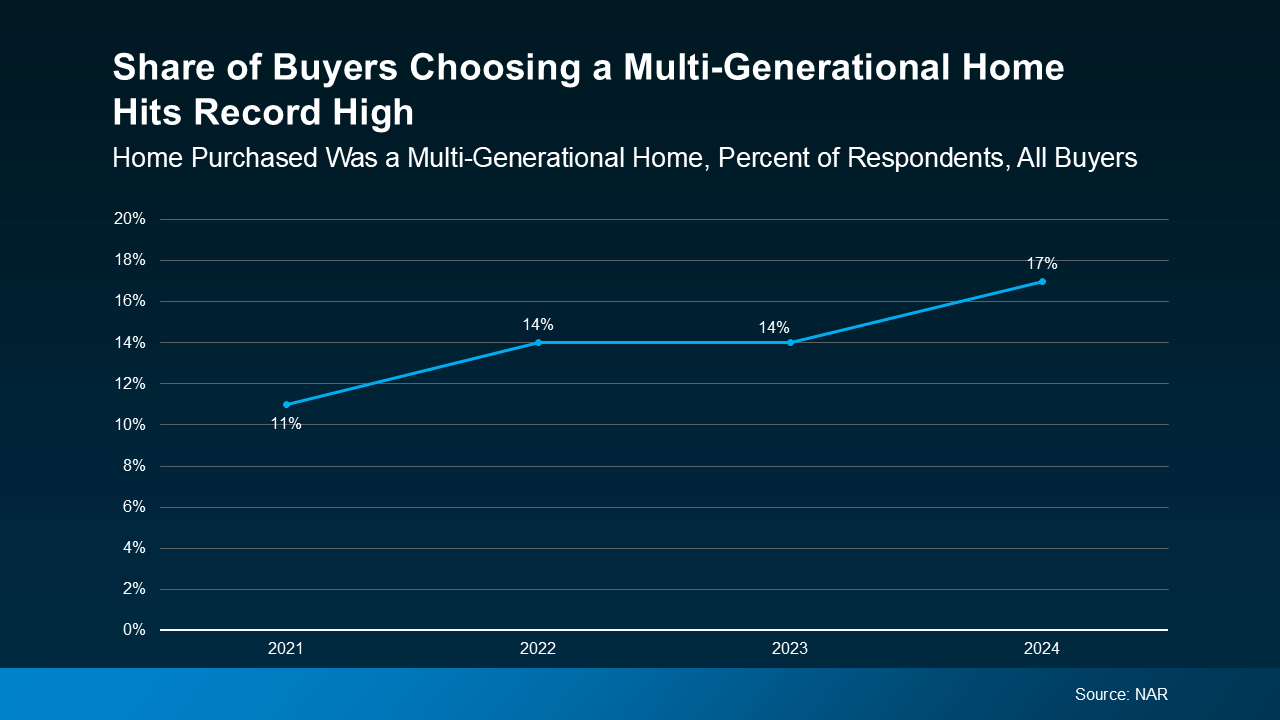
The share of buyers choosing a multi-generational home has climbed to a record high. Source: National Association of Realtors.
That’s not a blip on a chart. It’s a real shift in how families are thinking about a home purchase, and once you look at what’s driving it, the logic is hard to argue with.
Why families are combining households
For a long time, the main reason multiple generations moved in together was caregiving. Adult kids wanted to be near aging parents, or grandparents pitched in with the grandchildren. That’s still a big piece of it. But a different motivation has moved to the front: affordability.
Back in 2015, only about 15% of multi-generational buyers named cost savings as their main reason. Today that figure is roughly 36%. More than double in under a decade. What changed was, more or less, the whole market. Prices climbed, mortgage rates bounced around, and paychecks didn’t always keep up. Buyers who would have qualified comfortably a few years ago are the ones now getting squeezed, and it’s happening across age groups and income levels.
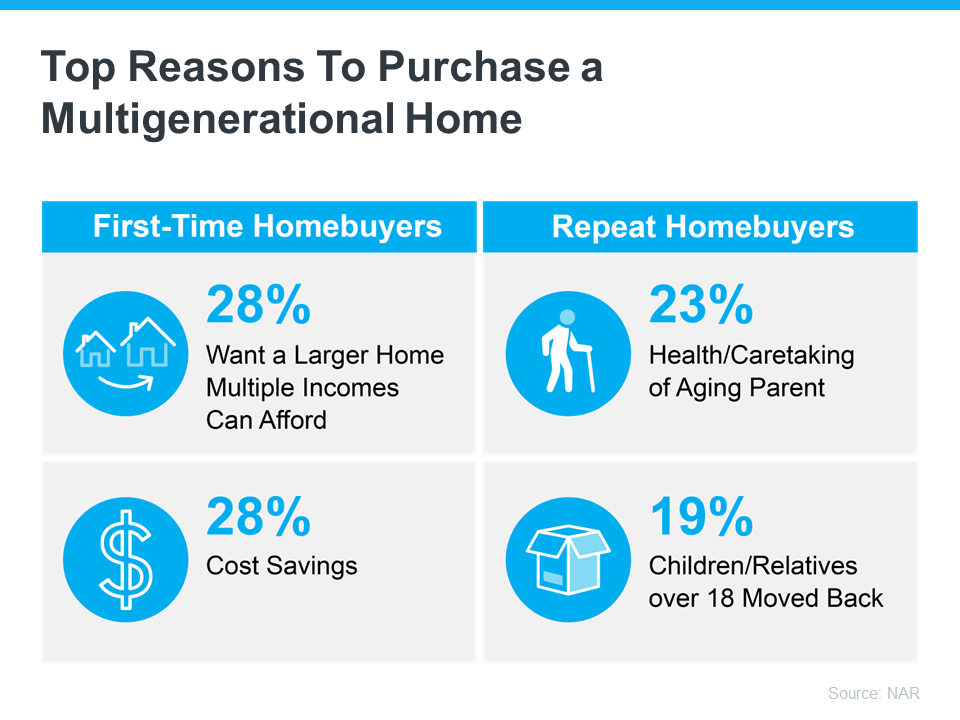
Cost savings and caring for aging parents lead the reasons families buy a multi-generational home. Source: National Association of Realtors.
There’s a version of this that’s purely defensive, families doing it because they have to. But a lot of buyers find the arrangement solves problems they weren’t even counting on, which is where it starts to look less like a compromise and more like a plan.
How the math changes when you pool resources
Buy a home on one income, or even two, and you’re capped by what those earnings support. Your lender looks at your income and your debts and lands on a number, and sometimes that number is well short of what a family-sized home in a good Memphis school zone actually costs.
Add another generation to the loan and the picture changes. Maybe it’s you and your spouse plus a parent with retirement income, or you and an adult child who’s established in a career. Suddenly you’re pooling incomes into a stronger application, and lenders can approve a larger amount than any of you would qualify for alone.
Qualifying is only half of it, though. The day-to-day cost of owning is where sharing really shows up. A mortgage is just the start. There are property taxes, insurance, utilities, repairs, and the surprise expenses that come with any house. Split those across several working adults and the weight on any one person drops fast. Picture a $3,000 monthly housing cost. Carry it alone or with a spouse and it can feel like a lot. Divide it among four adults and each is responsible for $750. That’s the kind of shift that turns “someday” into “this year.”
It’s the same instinct behind co-buying a home with family or friends, and it’s one of the moves families make when buying starts to feel out of reach. Pooling resources doesn’t just get you into a home. It often gets you into a better one, with the extra bedroom or the second living area that makes shared living actually work.
The sandwich generation angle
There’s a name for people raising kids and helping aging parents at the same time: the sandwich generation. If that’s you, you already know the pull in both directions, and how it drains both your schedule and your bank account.
Research suggests about one in six Americans is in that spot. And the part that surprises people: roughly a third of them say their situation has actually made it easier to afford a home. When everyone’s under one roof, a parent chipping in on the mortgage is money you’re not covering alone. Grandparents home during the day can mean the difference between paying for childcare and not, which in Memphis can run well over a thousand dollars a month per kid. For a lot of families, that single line item is what makes the payment work.
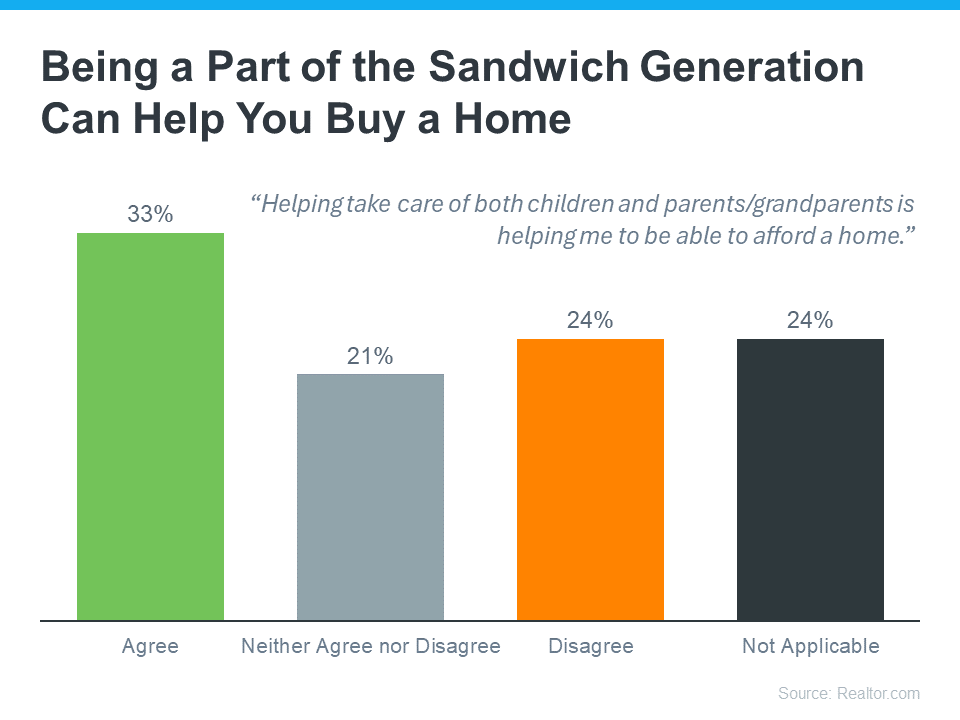
Being part of the sandwich generation can make buying a home more attainable, not less. Source: National Association of Realtors.
More than money: the everyday payoff
We’ve spent a lot of words on cost, because cost is what pushes most families to consider this in the first place. But the money is rarely the part people end up talking about a year in.
When a parent or grandparent lives with you, caregiving stops being a series of drives across town to check in, sort medications, and get to appointments. You’re already there. You help when it’s needed and enjoy their company when it isn’t, and for a lot of families that peace of mind is worth more than the savings.
Then there’s the ordinary stuff that scattered families miss. Kids eat breakfast with their grandparents. You catch a cup of coffee with your adult daughter before work. Aging parents watch their grandkids grow up in person instead of through a phone. Those small daily moments build closer bonds than holiday visits ever do. Older adults living with family tend to report better mental health and less isolation, and kids in multi-generational homes often grow up steadier, with a couple of extra adults in their corner.
What a multi-generational home actually needs
This is where the house hunt gets more involved than usual. More people means more opinions, more must-haves, and a floor plan that has to do more work.
Bedroom placement is usually the first thing to sort out. Aging parents often need a bedroom and full bathroom on the ground floor, away from stairs. Adult kids tend to want their space on a separate level for privacy. Enough bathrooms to avoid a morning traffic jam is not a small thing. A lot of families look for a bonus room, a finished basement, or a true in-law suite that gives one generation something close to their own apartment within the larger home.
Accessibility is worth planning for now rather than paying for later. If parents will be with you long-term, features like a step-free entrance, wider doorways, and a main-floor bed and bath can save an expensive renovation down the road. And it’s worth checking whether a property has room, and the zoning, to add an accessory dwelling unit later, since that flexibility keeps your options open as the family changes.
One local wrinkle: a lot of Memphis-area housing stock is single-story ranch or two-story traditional, and true multi-gen floor plans with a separate suite are less common than in some Sun Belt metros. They’re out there, especially in newer construction and larger lots around the suburbs, but finding the right layout takes someone who knows the inventory.
Finding one in the Memphis area
This is where the right agent earns their keep. Not everyone has run a multi-generational search, and the learning curve is real. You want someone who can spot the workable layouts before you ever schedule a showing, and who knows which neighborhoods have the larger homes that fit a pooled budget.
The suburbs are usually the first place to look. Larger lots and newer builds in Germantown, Collierville, and Bartlett tend to offer the square footage and the bonus-room or basement-suite setups that multi-gen living needs, and each area has its own feel and price point. If you’re weighing them against each other, our Collierville, Germantown, and Bartlett comparison breaks down where a family-sized home stretches furthest.
A good agent also helps when several family members are deciding together. When parents, adult kids, and maybe grandparents all have a say, having a neutral person keep everyone focused on the priorities is worth a lot. And if part of the plan is a parent selling their current home to buy in with you, it helps to know what that home is worth and what selling actually involves before anyone commits.
The trend isn’t slowing down
If you’re wondering whether this is a moment or a movement, the forward-looking numbers lean toward movement. Nearly three in ten buyers, about 28%, say they’re planning to purchase a multi-generational home. These aren’t people idly daydreaming. They’re serious enough to be out looking, and they’re specifically after multi-gen properties.

The benefits of buying a multi-generational home, from shared costs to built-in caregiving. Source: National Association of Realtors.
It helps that the timing is turning. As affordability is projected to keep improving into 2026 and the rate lock-in effect finally loosens, more homeowners are listing and more of the right-sized homes are coming to market. Families who’ve been waiting for the pieces to line up may find them sooner than they expected.
Start with the conversation
So is a multi-generational home right for you? That’s a question only your family can answer, and the honest first step isn’t a listing search. It’s a talk. How would you split expenses? Who handles which household tasks? How much privacy does each person need, and how will you handle the friction that comes with any group of adults sharing a home? Those conversations can feel awkward, but having them before you move in prevents most of the problems that show up later.
Be realistic about personalities, too. Some families genuinely thrive in close quarters. Others need more room to breathe, and there’s no wrong answer there. What matters is being honest about your own before you buy.
If you talk it through and the idea holds up, the next move is easy: reach out to an agent who’s actually done these searches around Memphis. A Reid Realtors agent can show you what your pooled budget affords, flag the homes with the right layout, and help several generations make one decision together. Get in touch whenever you’re ready, even if you’re just starting to float the idea past the family. Buying together is a bigger conversation than buying alone, and it helps to have someone in your corner who’s watched it work.