Most sellers walk into the market with one number stuck in their head. It’s the price they want, the price they’ve already spent in their imagination, the price they tell the neighbors. And more often than not, it’s the number that ends up costing them the most.
A 2026 seller survey from Realtor.com found that about 8 in 10 sellers expect to sell at or above their asking price right now. That’s the expectation. The reality is a different story. Only about 4 in 10 actually pull it off.
That’s a wide gap, and it’s where a lot of sellers get blindsided. So why the disconnect, and more to the point, how do you land in the 4 out of 10 who get top dollar instead of the 6 who don’t? Let’s walk through it.
What you should really expect to get for your house
Forty percent sounds low until you put it next to a normal year. Look back to 2019, the last genuinely typical stretch the housing market had, and what you’re seeing now is mostly a return to normal. If anything, slightly more sellers are clearing their list price today than did back then.
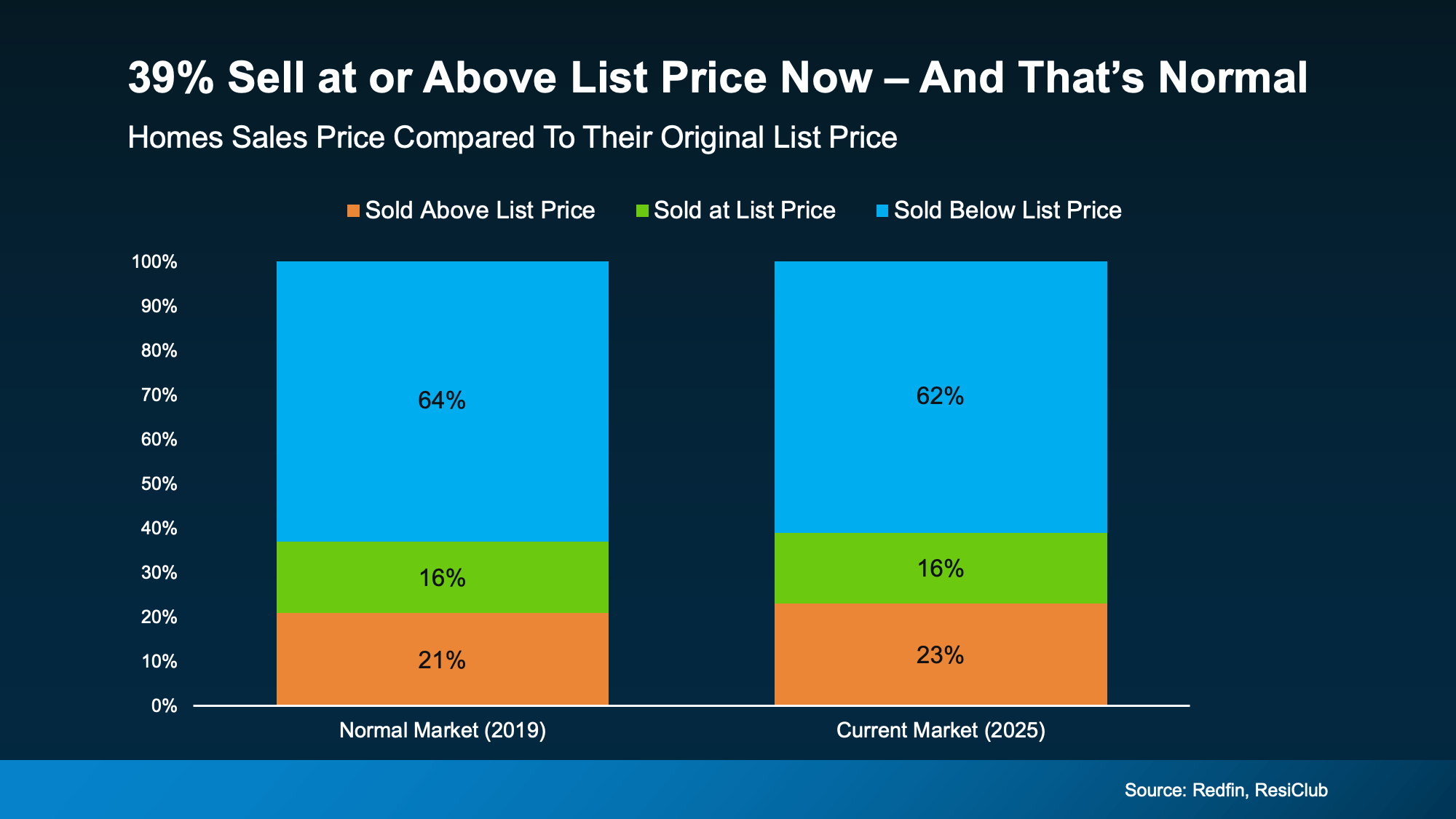
The reason 40% feels disappointing is that the last few years rewired everyone’s expectations. From 2020 through the middle of 2022, buyer demand was through the roof and there were almost no homes for sale. Nearly everything sold over asking, sight unseen, with offers stacked ten deep. That wasn’t normal. That was a once-in-a-generation imbalance, and it’s gone.
The market has shifted since then. There are more homes for sale, buyers have more to choose from, and that means they’re pickier about where their money goes. The rules that made overpricing work in 2021 don’t apply anymore. Pricing your home like it’s still the pandemic frenzy is the single most common way sellers leave money on the table. You can see the same supply-and-demand shift playing out locally in how the lock-in effect is finally breaking in 2026, which put a wave of new Memphis-area listings on the market and handed buyers options they didn’t have a year ago.
What happens when a home is priced too high
It’s tempting to think a high price gives you room to negotiate down. In this market, it usually does the opposite.
When your home is priced above what buyers expect for that area, they don’t counter. They scroll past. Buyers shop by price first, and if your number doesn’t line up with the comparable homes around you, your listing may not even earn a showing. From there it snowballs in a pretty predictable way:
- A high price draws less interest from buyers.
- Less interest means fewer showings and fewer offers.
- Fewer offers means more days on the market.
And time on the market is not a neutral thing. The longer a home sits, the more buyers assume something is wrong with it, even when nothing is. The table below from the Indiana Association of Realtors makes the pattern hard to argue with. It’s one state’s data, but the trend holds across most markets, including ours: homes listed at or under market value sell quickly, while overpriced homes linger. That delay carries a real cost.
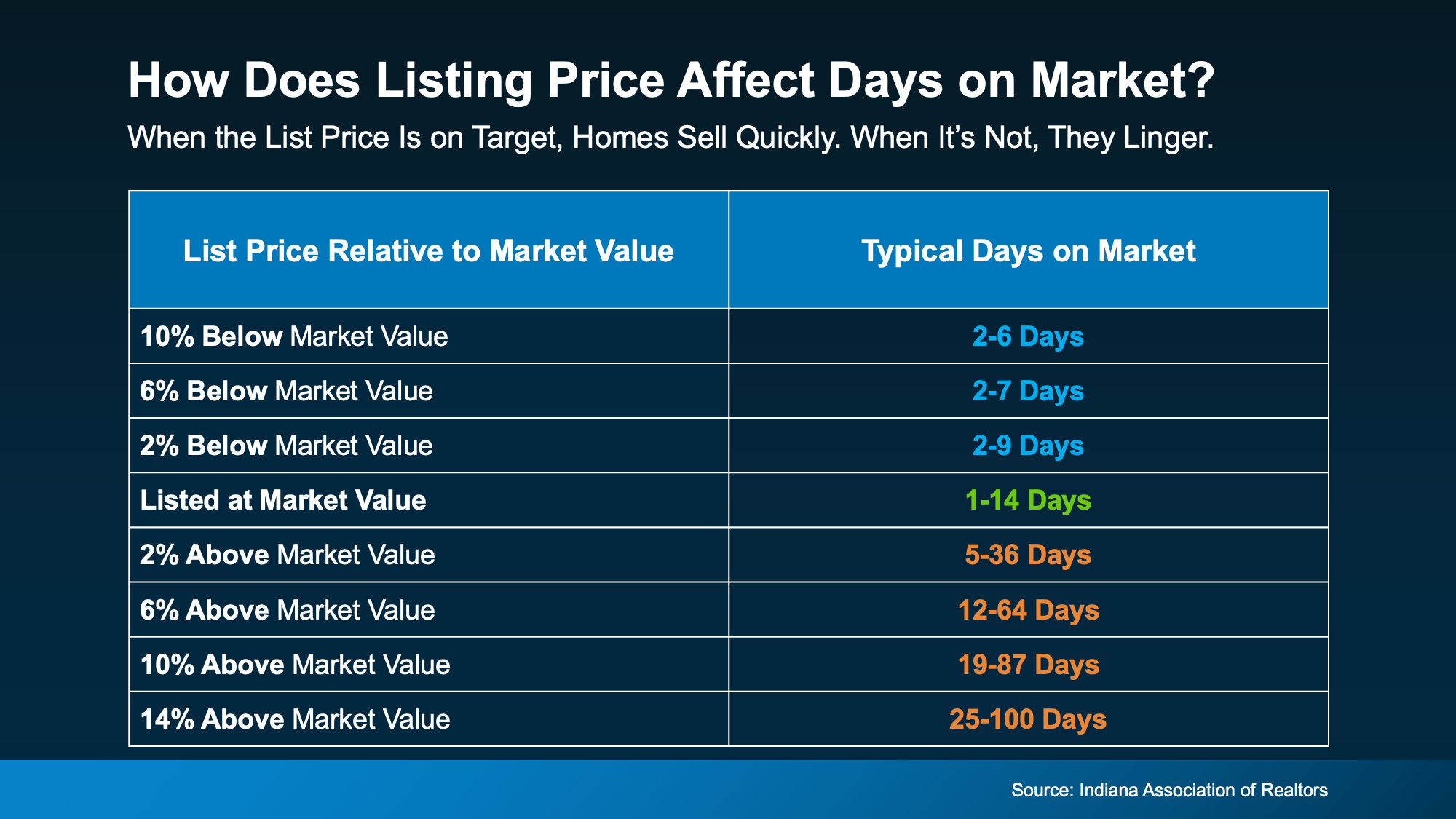
We see this constantly in the Memphis suburbs. A well-priced home in a strong school district can go from listed to pending fast, the way we broke down in how one Germantown listing went 50 days to pending. An overpriced home two streets over, same condition, can sit for two months and still need a cut to finally move.
The price-cut trap, and how to avoid it
When a home sits long enough without offers, most sellers reach for the obvious lever: a price reduction. As of this spring, about 16.7% of sellers are doing exactly that.
The catch is that a price cut doesn’t guarantee a sale. Worse, some buyers read a reduction as confirmation that something’s off with the house, even when the only thing wrong was the original number. So now you’ve got a stale listing and a nervous buyer pool.
It also tends to cost more the longer you wait. Data from the National Association of Realtors shows that the longer a home lingers, the bigger the eventual cut has to be to win buyers back. What started as “leave a little room to negotiate” turns into a series of reductions that nets you less than pricing it right would have in the first place.
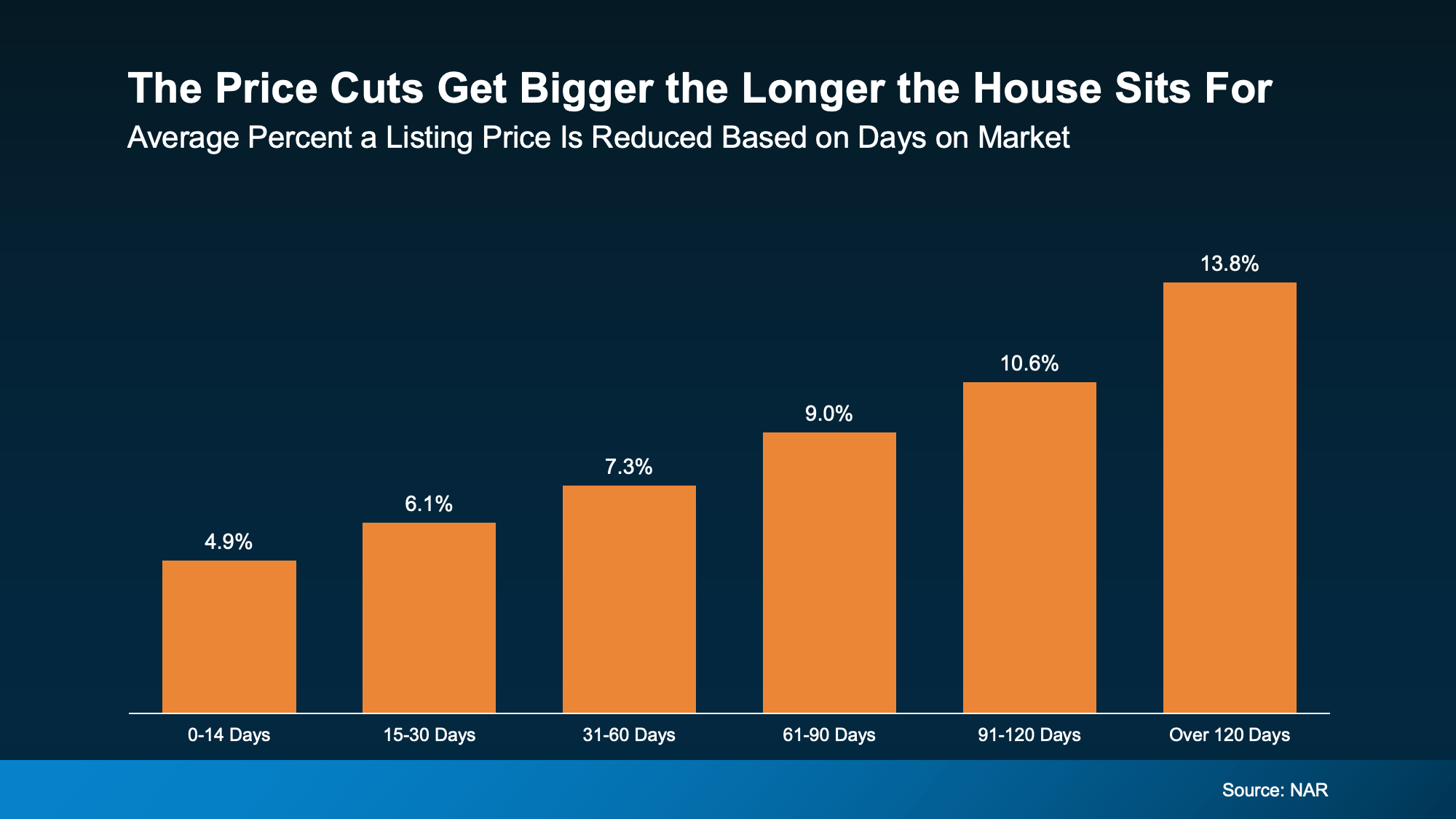
There’s a hard truth buried in that chart. The seller who “tests” a high price and adjusts later almost always ends up below the seller who priced it correctly from day one. You don’t get the early momentum back.
Why the first two weeks decide everything
This is the part most sellers underestimate. Your listing gets the most attention in its first ten to fourteen days. That’s when it hits every buyer’s saved search, lands in their inbox, and shows up as “new” on the apps. The buyers who’ve been watching your neighborhood for months all see it at once.
Price it right and that burst of attention turns into showings, and showings turn into offers while interest is hot. Sometimes that competition is what pushes the final number to or above asking. Price it too high and you burn that window on buyers who look, balk at the number, and move on. By the time you correct the price, the most motivated buyers have already bought something else. The audience you wanted is gone.
That’s why pricing isn’t a number you can fix later without a penalty. The first impression is the price, and you only get one.
Why pricing right from day one wins
Listing at, or even just under, market value can feel backwards when your goal is to get as much as possible. A lot of the time, it’s the strategy that actually gets you there.
The goal isn’t to throw out a high number and see what sticks. It’s to price in a way that creates demand from the first day. The NAR says it well: “While some sellers are pricing their homes higher than ever, a more ‘goldilocks’ frame of mind is a better approach to avoid price cuts and lingering time on the market.”
There’s a sweet spot. Price too high and buyers vanish. Price too low and they wonder what’s wrong. Land it right in the middle and you create the competition that gets you the most money. Priced correctly, a home can draw multiple offers and sell at or above asking precisely because it didn’t scare buyers off at the door.
That middle is also harder to find than it looks, which is where a good agent earns their keep.
How a good agent actually prices a home
Pricing isn’t a guess, and it isn’t whatever number makes you feel good. The right agent prices your home with a comparative market analysis, a close look at what similar homes near you have recently sold for, what’s currently competing with you, and what’s sitting unsold and why.
A strong CMA accounts for the things a website estimate can’t see: your updates, your lot, your exact street, your school zone, the condition of the homes you’re competing against this month. It tells you what buyers are paying right now, not what your neighbor got eighteen months ago at the top of the market. That difference is often thousands of dollars. Choosing someone who knows your specific market matters more than most sellers expect, which is why we put together a guide on how to choose a great local real estate agent.
The right number does more than attract buyers. It sets you up to negotiate from strength. When a well-priced home draws several interested buyers, you hold the leverage, and the conversation shifts from “will it sell” to “which offer is best.” We get into that side of it in our breakdown of negotiation strategies for a balanced 2026 market.
What “priced right” looks like in the Memphis market
Pricing right is local, and the Memphis metro doesn’t move as one market. Germantown and Collierville behave differently than Cordova or Bartlett, and even within a single suburb, two neighborhoods can carry different price-per-square-foot expectations and different buyer pools.
Homes in Germantown and Collierville priced to current comps in good school zones still draw quick, competitive interest, while the same home priced on peak-market nostalgia stalls. In Bartlett and Cordova, where buyers are often watching their budgets a little more closely, the penalty for overpricing shows up even faster. The number that creates a bidding war in one zip code is the number that gets ignored two zip codes over. National averages won’t tell you any of that. Recent local sales will.
How to set yourself up to get your price
Getting your asking price is less about the number on day one and more about everything that supports it. A few things move the needle most.
Price to current comps, not to what you paid or what you wish you could get. The market sets your value, and fighting it just costs you time and, eventually, money.
Get the home ready before it lists. Clean, declutter, handle the deferred maintenance, and make the first photos count. The right prep work also protects your price, which is why we mapped out the home improvements worth doing before you sell. A move-in-ready home justifies its price in a way a tired one can’t.
Time it with intent. Sellers who list when buyer activity is strongest tend to have the upper hand, something we covered in why spring sellers have an edge. And if you want a sense of where the broader market is headed, the latest forecasts point to affordability improving through 2026, which is slowly bringing more buyers back into the pool.
Do those things, price it correctly out of the gate, and you give yourself a real shot at being one of the 4 in 10. Skip them and overprice, and you’re far more likely to learn the price-cut lesson the expensive way, the same one we walk frustrated sellers through in what to do when your house didn’t sell.
Price it right the first time
A lot of sellers believe they can list high now and negotiate later. In this market, that belief is what keeps most of them out of the 4 in 10 who get their asking price. The number you choose on day one sets the tone for everything that follows, and you don’t get the early momentum back once you’ve lost it.
If you want to be in that group, it starts with getting the price right from the start, backed by real local data and a clear-eyed look at what buyers are paying today. That’s the part we do every day across the Memphis suburbs. When you’re ready to sell, reach out to our team and we’ll price your home on what the market is actually doing, not on hope, so it sells once, sells well, and sells for what it’s worth. You can also start with our seller resources to see what the process looks like from here.